
You’ve probably never heard of Lake Angelus, Michigan — and that’s exactly how the residents prefer it. Tucked quietly into northern Oakland County just outside Metro Detroit, Lake Angelus isn’t under the radar… it’s intentionally absent from it. There’s no downtown, no commercial corridor, no bustling main street — and with fewer than 300 residents, there’s barely even a population to market.
Yet behind that silence sits one of the most exclusive and wealth-concentrated communities in the entire state of Michigan.
So why does nobody talk about Lake Angelus? Because what happens around this private lake community tends to stay there. Today, we’re pulling back the curtain — covering the history, the lifestyle, the real estate reality, and the true costs of living in one of Metro Detroit’s most elusive enclaves.
A Population Measured in Neighbors, Not Thousands
With fewer than 300 residents, Lake Angelus is one of the smallest incorporated cities in Michigan. To put that into perspective, many Michigan high schools graduate more students each year than live in this entire city.
The median age hovers around 65, significantly higher than both Michigan and national averages. This is not a nightlife-driven, high-turnover suburb — it’s a community of established professionals, retirees, and long-term residents who value privacy above all else.
Crime is virtually nonexistent, not because of heavy policing or dense infrastructure, but because of the scale, wealth, and intentional isolation of the community.
One of the Wealthiest Cities in Michigan (Quietly)
Lake Angelus consistently ranks as the wealthiest city in Michigan by household income. Recent data places the average household income around $390,000+, with per-capita income among the highest in the state.
This wealth concentration, combined with the city’s microscopic population, creates a unique dynamic: extreme affluence without public visibility. There are no attractions, no festivals, no downtown draw — and that’s by design.
The History Most People Don’t Know
Originally known as Three Mile Lake, the area began as rural Oakland County farmland in the early 1900s. As Detroit’s automotive boom created new wealth, affluent Detroiters started purchasing land around the lake as summer retreats.
In the 1920s, a resident named Mrs. Sollace B. Collidge pushed to rename the lake “Lake Angelus,” reportedly inspired by religious symbolism. The name stuck, and so did the community’s desire for independence.
Concerned about annexation by neighboring cities, residents successfully petitioned the Michigan Legislature to incorporate as a village in 1929, officially becoming a city in 1984. While the “city” designation might sound grand for a place with no traffic lights or sidewalks, it granted Lake Angelus exactly what it wanted: control, autonomy, and privacy.
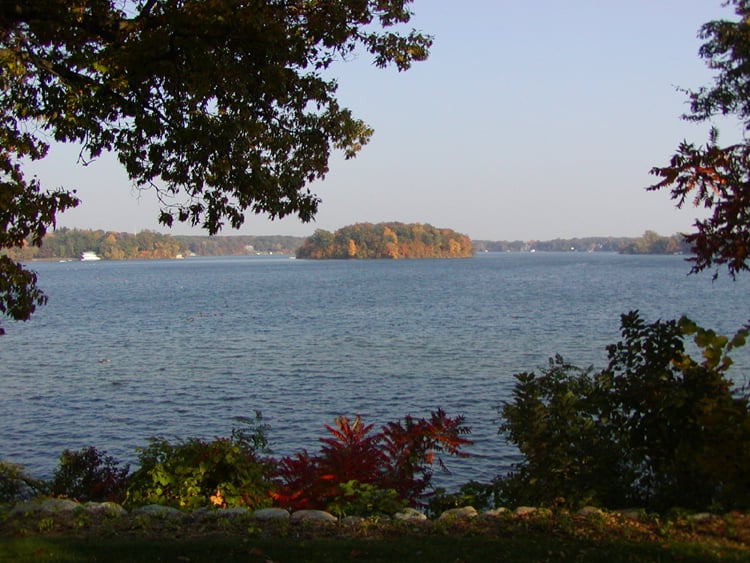
Credit: - Own work
Life on a Fully Private, All-Sports Lake
Lake Angelus is a private, all-sports lake, meaning only residents and their guests can access it. Boating, waterskiing, paddleboarding, and fishing are all common — without the congestion found on public lakes.
In winter, the lake becomes a frozen playground for skating, pond hockey, and quiet walks across snow-covered ice. It’s a year-round lifestyle that feels more like a private resort than a suburb.
And when residents want amenities? They’re minutes from Great Lakes Crossing, Pine Knob, and major highways — close to everything, but untouched by it.
Schools & Districts
Lake Angelus does not operate its own school system. Most homes fall within either the Pontiac School District or Waterford School District, depending on exact location.
That said, school districts are rarely the driving factor for buyers here. Lake Angelus tends to attract residents prioritizing privacy, lakefront living, and estate-scale homes over walkable schools or youth-focused amenities.
Real Estate Reality: Extremely Rare, Extremely Expensive
Lake Angelus real estate is defined by scarcity.
As of mid-2025, average sale prices approached $2.9–$3.0 million, with only a handful of transactions annually. In many years, fewer than 5–6 homes sell total. When a single $5M–$6M waterfront estate trades, it dramatically skews averages.
Recent listings have ranged from roughly $1.5M to over $6.4M, including new construction estates with extensive frontage and acreage. One such property is currently listed through my brokerage Sotheby's International Realty, reflecting the caliber of homes common here.




Living in Pleasant Ridge Michigan: The Tiny City …
Discover what makes Pleasant Ridge, Michigan unique,…
Living in Utica Michigan: What You Need to …
Discover what it's like living in Utica,…
Living in Rose, Springfield & Tyrone Townships Michigan: …
Discover what it’s like living in Rose,…