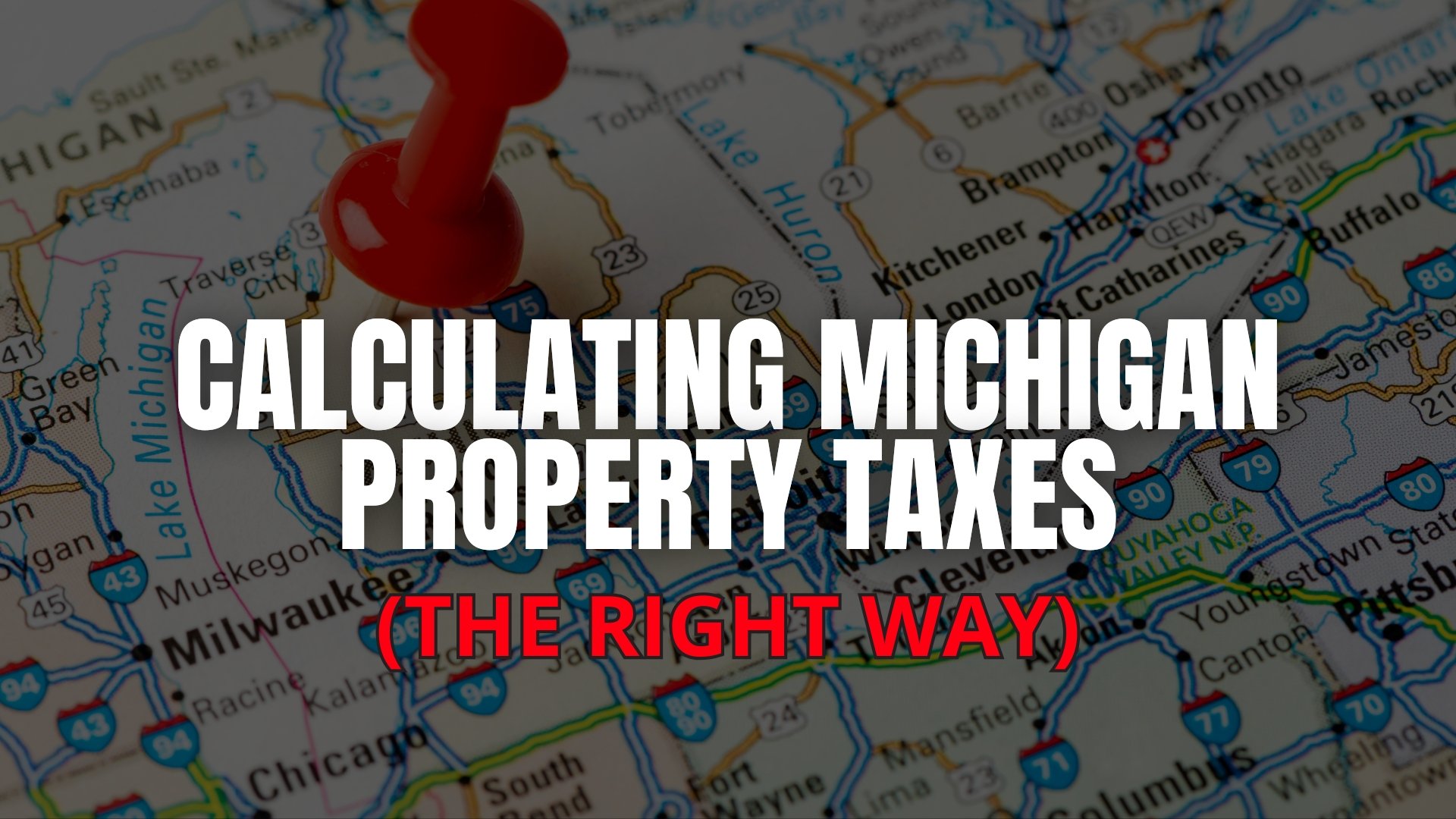
How to Calculate Michigan Property Taxes
The State of Michigan’s Property Tax Estimator lets you estimate taxes by local unit and school district. You’ll enter either your SEV (for future owners/buyers) or your Taxable Value (for current owners), then choose your county, city/township/village, and school district to see projected bills. The estimator currently displays results using the most recently posted statewide millage table noted on the page. treas-secure.state.mi.us
Quick glossary
SEV (State Equalized Value): Usually about 50% of market value; use this if you’re estimating taxes as a future owner (buyer).
Taxable Value: What current owners pay taxes on; it increases annually by inflation or 5% (whichever is lower) until “uncapping” at sale.
A) If You’re a Buyer (Future Owner)
Use this when you want to know post-purchase taxes after uncapping.
Open the estimator
Visit the Michigan Property Tax Estimator: treas-secure.state.mi.us/ptestimator.
On the landing view you’ll see instructions to enter SEV for future owners or Taxable Value for current owners, then select your county; you’ll be prompted for your local unit and school district next. treas-secure.state.mi.usCalculate your SEV
Take your expected purchase price (or market value) and divide by 2.
Example: $320,000 purchase price → SEV ≈ $160,000.
Enter the SEV
Type your SEV in the “For future owners, enter the SEV” field.Select your County
Choose the county from the dropdown list. (All 83 Michigan counties are available.) treas-secure.state.mi.usSelect your Local Unit and School District
You’ll be prompted to pick your city/village/township and then the school district serving the property. (Millage varies by both.) treas-secure.state.mi.usReview the Results
The tool will show an estimated annual property tax at the selected location/school district. (It reflects the posted statewide millage table shown on the estimator page.) treas-secure.state.mi.us
Buyer Pro Tips
- If you’re planning to claim the Principal Residence Exemption (PRE) as your primary home, focus on the “homestead/primary residence” figure (if shown) or use the millage minus the 18-mill school operating levy when comparing.
- If it will be a rental/Airbnb/second home, use non-homestead figures (these are typically ~25–35% higher because they don’t get the PRE reduction).
- Remember: after closing, your taxable value uncaps (resets to market), so ignore the seller’s old bill when budgeting.
B) If You’re a Current Owner
Use this when you already own the home and want to sanity-check your next bill.
Open the estimator
Go to treas-secure.state.mi.us/ptestimator. treas-secure.state.mi.usEnter your current Taxable Value
Use the “To estimate property taxes paid by the current owner, enter the taxable value” field. You’ll find Taxable Value on your most recent tax bill or assessment notice.Select your County
Pick the county from the dropdown. treas-secure.state.mi.usChoose your Local Unit and School District
Select the city/village/township and the correct school district. treas-secure.state.mi.usReview the Results
Compare the estimator’s output with your actual bill. If your bill is materially different, check for special assessments or changes not reflected in the posted millage table on the site. treas-secure.state.mi.us

Worked Example (Buyer)
- Purchase price: $320,000 → SEV ≈ $160,000
- Enter SEV: 160,000
- Select county/local unit/school district: (example) Oakland County → [your township] → [your school district]
Read the output: You’ll see the projected annual total. For a quick mental check, remember that total tax ≈ Taxable Value × (millage/1,000). After purchase, your Taxable Value ≈ SEV (because of uncapping), so you can approximate:
If composite millage were ~40 mills: $160,000 × 40 / 1,000 ≈ $6,400/year.

Common Pitfalls & How to Avoid Them
- Relying on the seller’s tax bill: That bill often reflects years of capped taxable value; your post-sale bill will be higher due to uncapping.
- Wrong school district: Two homes across the street can have different school millages—double-check the district.
- PRE assumption errors: If it’s not your primary residence, remove the PRE effect when comparing.
- Special assessments: The estimator notes that certain localized assessments aren’t included; verify with your local assessor if your property has extra charges. treas-secure.state.mi.us
- The calculator has a disclaimer at the bottom stating they may using the previous years millage rates up until August of the current year, so you may have to cross reference with the millage rate PDF of that current year which you can find here: https://www.michigan.gov/taxes/property/estimator/related/millage-rates
Notes About the Estimator
- The page explains you can estimate by local unit and school district by entering SEV (future owners) or Taxable Value (current owners), then selecting county, etc. treas-secure.state.mi.us
- It also includes a notice about which millage year the tool is currently using statewide and that some special/local assessments may not be included in the estimate. Always confirm specifics with your city/township assessor. treas-secure.state.mi.us

Andrew McManamon
Founder of Living In Michigan
Michigan Realtor®
[email protected]
Contact Us
www.LivinginMichigan.com
Check out recent articles

The Truth About Allen Township, Michigan: Neighborhoods, Prices, …
Allen Township, Michigan offers a rural Hillsdale…

Is Adams Township (Hillsdale County), Michigan a Good …
Adams Township, Michigan is a rural Hillsdale…

Moving to Reading, Michigan? What to Know About …
Reading, Michigan is a small Hillsdale County…
Check out this article next

You'll NEVER Believe These Rochester Michigan Home Prices!
Explore five real homes under $450K and discover what living in Rochester, Michigan is really like — from condos to historic charmers and modern condos.
Read Article


Leave a Reply
You must be logged in to post a comment.