
introduction
Sturgis isn't trying to be anyone's trendy relocation destination. It's a real city — Michigan's largest in St. Joseph County — with a working identity that traces back to manufacturing, a hydroelectric dam, and a founding story that involves biscuits, a judge, and a Michigan governor named Lewis Cass. If you're looking for a place in southwest Michigan where your dollar goes further than the national average, where the housing market is genuinely accessible, and where the kind of outdoor recreation that most people drive hours for is essentially in your backyard, Sturgis is worth your time.
This guide gives you the full picture: where Sturgis sits geographically, what housing costs and property taxes actually look like, how the schools are rated, what there is to do, and an honest list of pros and cons you can actually use in your decision-making. No fluff, no fabricated statistics.
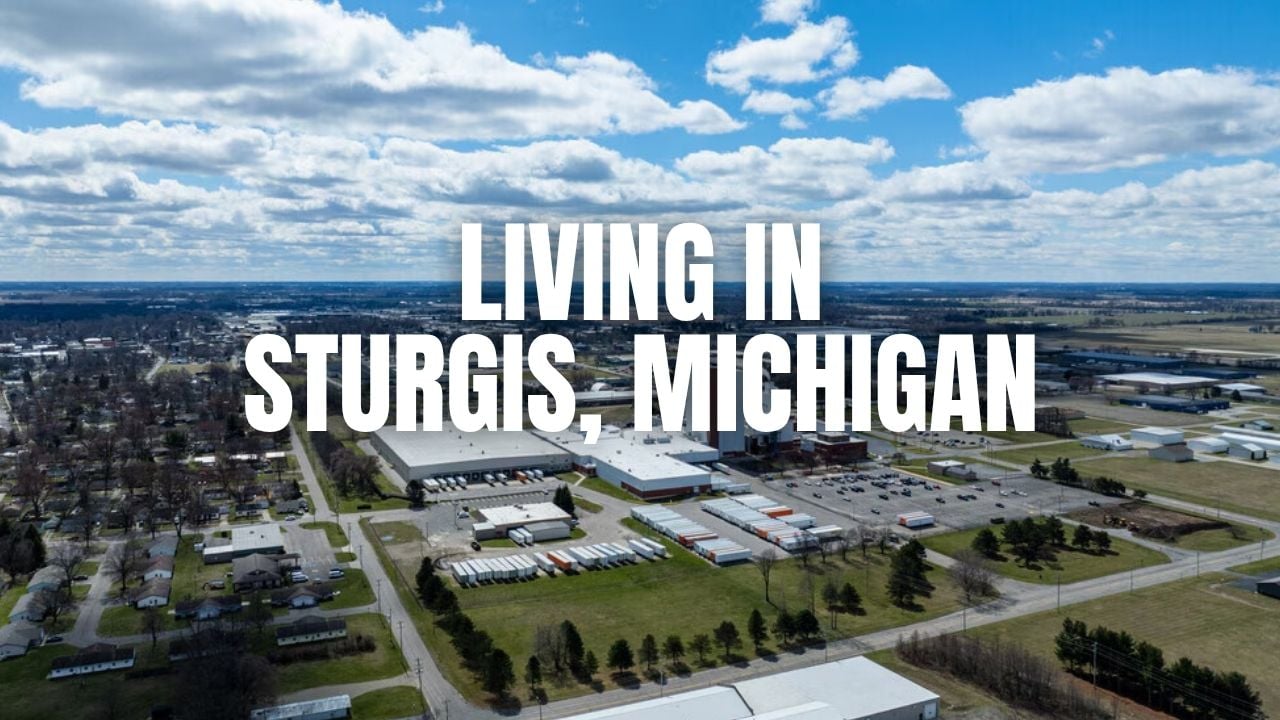
Cost of Living in Sturgis, Michigan
Sturgis is one of the more affordable cities in Michigan on a pure cost-of-living basis. According to City-Data.com, which aggregates U.S. Census data, the December 2024 cost of living index for Sturgis was 75.6 — well below the U.S. average of 100. That positions Sturgis as meaningfully less expensive than the national baseline across the major categories that drive everyday household budgets.
Per Data USA (drawing on ACS 2023 5-year estimates), the median household income in Sturgis was $60,640, up 7.64% from the prior year. World Population Review cites the median household income at $60,640 and a poverty rate of approximately 15.98% — above the Michigan statewide rate of approximately 13.2%, reflecting the city's manufacturing-oriented economic base and the income volatility that can accompany it. Per capita income is approximately $28,315, per City-Data.com.
The median estimated home or condo value in Sturgis as of 2023 was $140,401, per City-Data.com citing U.S. Census Bureau ACS data. Median gross monthly rent is approximately $805 per month, per the same source. These figures represent a housing market that is substantially below the Michigan statewide typical home value of $237,918, per Zillow — meaning Sturgis offers real ownership accessibility for buyers who can't or don't want to compete in higher-priced Michigan markets.
According to City-Data.com, median real estate property taxes paid for Sturgis housing units with mortgages in 2023 were approximately $1,734 — a figure that reinforces the city's affordability profile. A personal vehicle is essential for most daily activities in Sturgis; there is no public transit service within the city, though St. Joseph County Transit Authority operates the Sturgis Circle Line, per Grokipedia, providing some intra-city and county-level public transportation service.
Real Estate & Housing Overview in Sturgis, Michigan
Housing Market Overview in Sturgis
The Sturgis, Michigan real estate market is characterized by accessible price points relative to state and national averages, moderate inventory, and transaction volumes that reflect the city's population of approximately 11,000. According to Redfin, the median listing price in Sturgis is approximately $206,000, with most homes staying on the market for approximately 44 days. Movoto reported a median listing price of $239,000 as of February 2026, with homes spending a median of 96 days on the market that month. The variance across reporting periods reflects typical seasonality in a smaller market where individual transactions can shift monthly statistics meaningfully. Inventory levels tend to vary by season, as is consistent with most Michigan housing markets. The market is not characterized by the intense competition found in higher-demand Michigan metros — buyers in Sturgis typically have time to be deliberate in their decision-making.
Types of Homes in Sturgis
Living in Sturgis, Michigan means access to a genuinely diverse range of housing types. The city's core features older-stock housing with significant character — Victorian and Craftsman-era homes, bungalows, and early-20th-century two-stories with established lots and tree-lined streets. According to City-Data.com and ACS data, approximately 24.9% of Sturgis housing units were built before 1940, giving the in-city housing stock considerable architectural variety and history. Ranch-style homes from the mid-20th century are also prevalent in residential neighborhoods. More recent construction — only 2.7% of units were built after 2000 per City-Data.com — is limited, meaning the market is primarily composed of existing homes. Lakefront cottages and properties with access to Klinger Lake and other nearby water bodies represent a distinct upper-tier segment for buyers seeking water access. Multi-family properties and rental units make up a meaningful share of the housing supply given the city's 40.6% renter occupancy rate, per City-Data.com/ACS.
Price Range & Affordability (Evergreen Style)
Homes in Sturgis, Michigan fall at the lower end of the price spectrum relative to Michigan as a whole. Per Redfin, the median listing price sits around $206,000, and per Movoto, the median listing price is approximately $239,000 depending on the month. The U.S. Census Bureau's ACS data places the estimated median home value at $140,401 — which represents the cross-section of all owner-occupied units including older, lower-value properties. For context, Zillow reports Michigan's statewide typical home value at $237,918, while the national median sits significantly higher. Sturgis is priced below both benchmarks across most of its housing stock.
Updated or fully remodeled homes in desirable neighborhoods command meaningfully higher prices than the median, and lakefront or lake-access properties near Klinger Lake are priced at a substantial premium to the city's overall average. Buyers should review current listings on Realtor.com, Redfin, Zillow, or Trulia for the most accurate and current pricing.
Market Segments & Buyer Activity (Neutral Language)
Sturgis supports a well-defined entry-level market, with a substantial number of properties priced at or below $150,000 — a segment that is increasingly rare in Michigan's larger markets. Move-up demand for three- and four-bedroom homes in established city neighborhoods is present and consistent with seasonal Michigan patterns. New construction interest is limited by the near-absence of new development activity within city limits, given that only 2.7% of the city's housing stock was built after 2000, per ACS data. Lakefront and lake-access properties represent an upper-tier segment. Rental demand is strong relative to ownership demand compared to the state average, given the city's 40.6% renter occupancy rate, per City-Data.com/ACS. Low-maintenance options, including smaller bungalows and ranch-style homes in good condition, are available and represent a popular segment of the resale market.
New Construction & Development Trends
Sturgis is not a market driven by new construction. The minimal post-2000 housing stock identified in ACS data reflects a built-out city where available parcels for new residential development are limited. That said, Grokipedia notes that Sturgis experienced an influx of new retail and restaurant establishments in 2023 and 2024, suggesting commercial development activity that may support increased residential interest over time. Buyers specifically seeking new construction should look at the broader St. Joseph County area or inquire about custom builds on available acreage parcels outside the city's core, as options within city limits are limited.
What It's Like to Own a Home Here
Owning a home in Sturgis, Michigan is a low-overhead experience by Michigan standards. The city provides municipal electric service — one of Sturgis's distinctive features since its earliest days — alongside water, sewer, and parks infrastructure, per sturgismi.gov. The city's Department of Public Safety integrates police, fire, and emergency medical services, per Grokipedia. Lot sizes within the city vary considerably: older-stock neighborhoods feature traditional city lots with mature trees and established landscaping, while properties on the city's edges offer more generous acreage. HOA presence is minimal across most of Sturgis's residential stock, consistent with its working-city character. Property upkeep on older homes should be factored into budget planning — the pre-1940 stock, while full of character, may carry deferred maintenance or system updates that newer homes would not. Buyers interested in moving to Sturgis Michigan should budget accordingly for inspections on older-stock properties.
If you're considering a move to Sturgis and want to better understand how the housing market fits your budget and goals, reviewing current listings on Realtor.com, Redfin, Zillow, or Trulia — and running property-specific numbers — can help you make a more informed decision.



The Truth About Three Rivers, Michigan: Neighborhoods, Prices, …
Thinking about living in Three Rivers, Michigan?…
Is Sturgis, Michigan a Good Place to Live? …
Sturgis, Michigan is the largest city in…
Moving to Vicksburg, Michigan? What to Know About …
Vicksburg, Michigan is a fast-growing village in…