
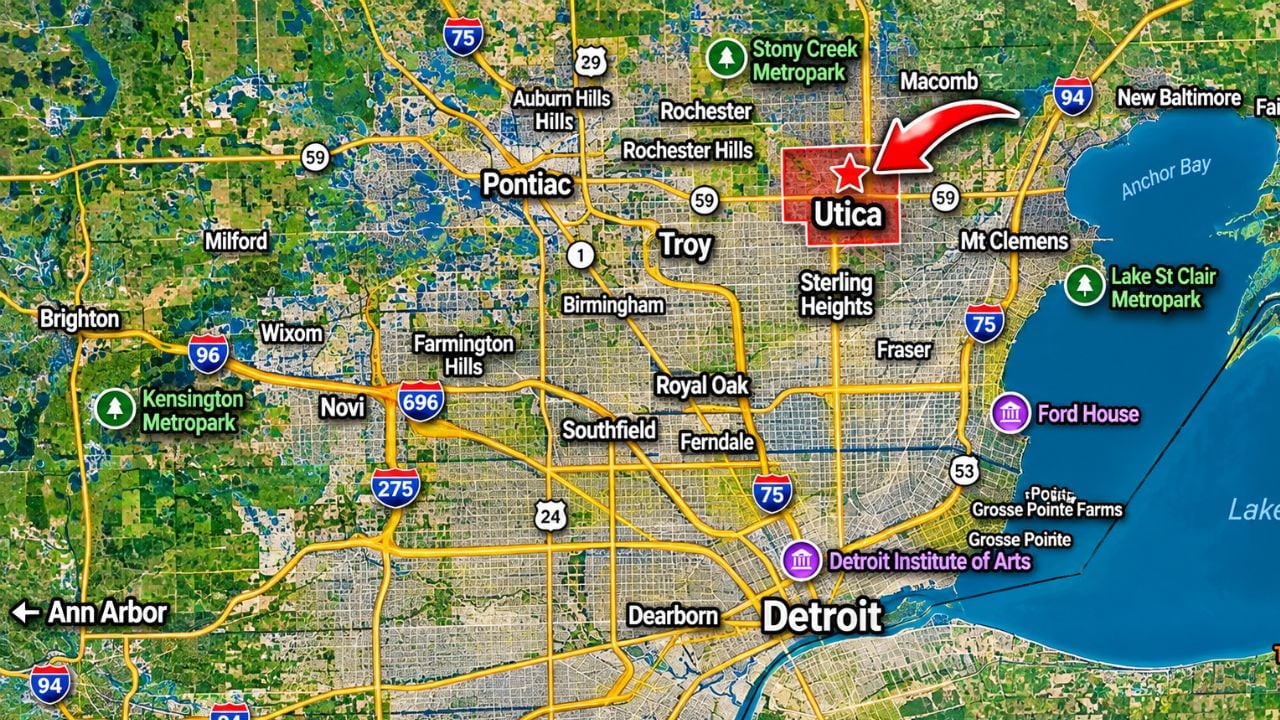
Utica, Michigan, is one of the smallest cities in Metro Detroit, but it has a surprisingly big identity. Located in Macomb County, this city covers just 1.78 square miles and has approximately 5,200 residents. Yet its name is attached to one of Michigan's largest school districts, its downtown has a history dating back nearly 200 years, and its location places residents minutes from some of the busiest commercial corridors in Southeast Michigan.
Here's what makes Utica particularly interesting: living in the City of Utica and living within Utica Community Schools are not the same thing. You can purchase a home in several surrounding municipalities and still fall within the same school district, potentially with substantially different property taxes.
That distinction can make a real difference when deciding where to buy.
Whether you're relocating to Metro Detroit, considering buying your first home in Macomb County, or comparing Utica with Shelby Township and Sterling Heights, this guide covers the housing market, downtown, schools, taxes, commuting, local history and everyday lifestyle.
Is Utica Michigan Part of Metro Detroit?
Yes. Utica is part of Macomb County and the Detroit metropolitan area. It is located in the northern suburban portion of Metro Detroit, near Shelby Township, Sterling Heights and Rochester Hills.
Residents can access nearby employment centers in Troy, Auburn Hills, Sterling Heights and Warren while remaining connected to Downtown Detroit through the regional road network.
How Big Is Utica Michigan?
Utica covers approximately 1.78 square miles, making it considerably smaller than neighboring Shelby Township and Sterling Heights.
That compact size is an important part of understanding the community. Unlike larger suburbs that contain numerous neighborhoods and commercial districts, Utica has a relatively small housing market and a concentrated downtown area.
It also explains why people sometimes confuse a Utica mailing address with living inside the actual city.
City of Utica vs Utica Mailing Address: What's the Difference?
This is one of the most important distinctions for anyone researching homes in Utica, Michigan.
A Utica mailing address does not necessarily mean a property is located within the City of Utica.
Some properties using Utica-related postal addresses may actually be located in neighboring municipalities, including Shelby Township or Sterling Heights.
Municipal boundaries determine which local government provides services and which municipal property taxes apply. School district boundaries are a separate consideration.
Before purchasing a home, verify the actual municipality, school district, parcel identification number and property tax jurisdiction rather than relying exclusively on the mailing address displayed on a real estate listing.
The History of Utica Michigan
Utica's history began long before the surrounding area became the suburban landscape we recognize today.
The community was platted in 1829 by Joseph Stead and was originally known as Harlow. During its early development, the settlement was also associated with names such as Hog's Hollow and McDougalville.
Eventually, the name Utica was adopted, reflecting the influence of settlers who had migrated west from New York.
Like many communities in northern Macomb County, early Utica developed around agriculture, local commerce and transportation.
Farms and agricultural businesses dominated the surrounding landscape before the automobile industry's expansion transformed southeastern Michigan.
By the middle of the twentieth century, automotive manufacturing and suburban development were reshaping nearby Sterling Heights and Shelby Township.
Utica gradually transitioned from a small agricultural community into a city surrounded by growing Metro Detroit suburbs.
Why Does Downtown Utica Look Different From Other Historic Michigan Downtowns?
Utica's downtown has a history that includes major fires in the early twentieth century.
Fires in 1905 and 1906 destroyed portions of the community's early commercial buildings, leading to rebuilding and changes in the downtown streetscape.
As a result, downtown Utica does not have the same concentration of original nineteenth-century commercial buildings found in some other historic Michigan downtowns.
Nevertheless, the downtown remains an important part of the city's identity, with local businesses, restaurants and historic connections along Cass Avenue and Auburn Road.
What Is Downtown Utica Michigan Like?
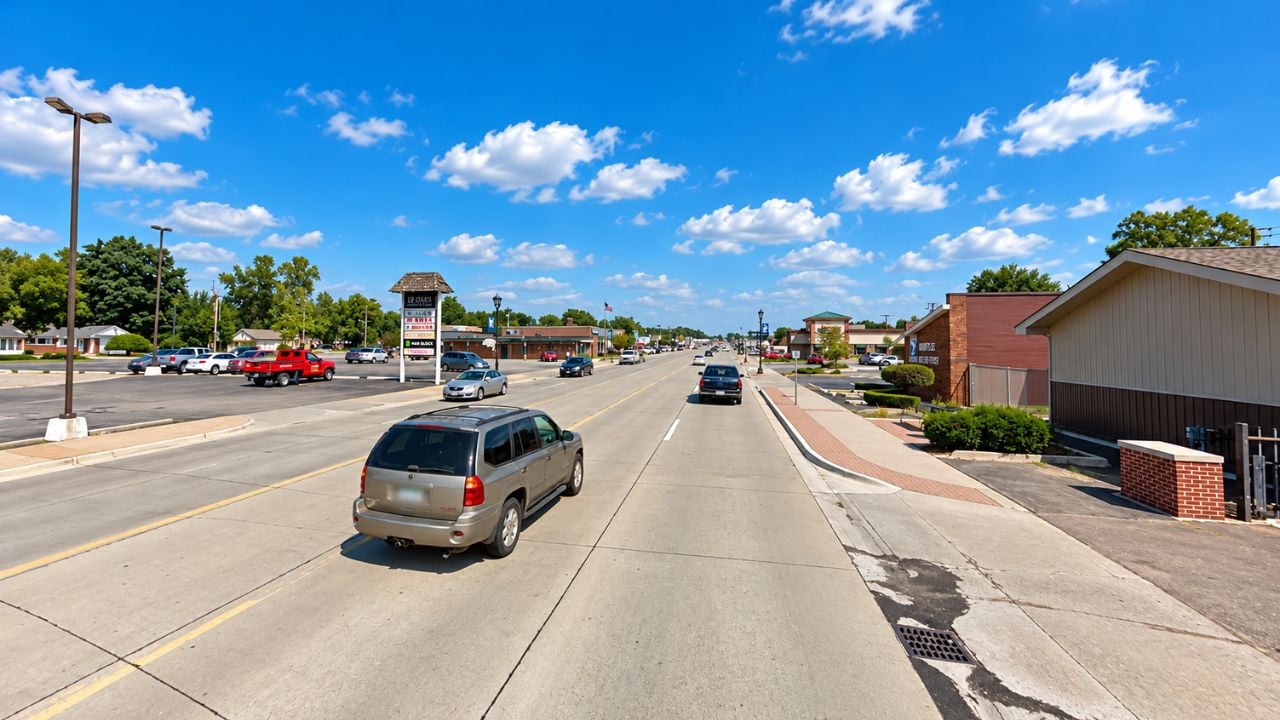
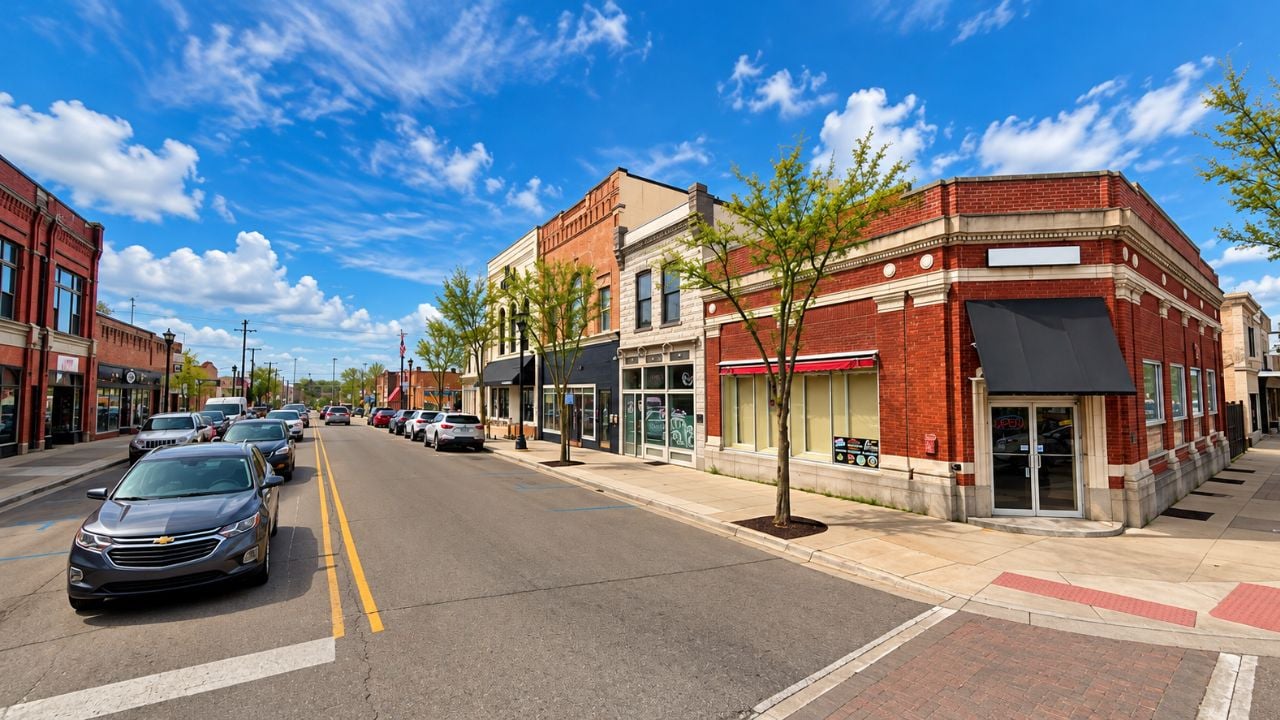
Downtown Utica is one of the city's most recognizable features.
Centered around Cass Avenue and Auburn Road, the downtown district offers a more traditional small-town commercial environment than the large shopping corridors surrounding it.
You'll find locally operated restaurants, businesses and places to gather, all within a relatively compact area.
That is a noticeable difference from much of nearby Hall Road, where shopping centers and larger commercial developments are spread across several miles.
Downtown Utica provides a different experience. Instead of driving from one large shopping plaza to another, visitors can explore a smaller collection of businesses within a historic downtown setting.
However, walkability depends on where you live. A home close to Cass Avenue may offer convenient pedestrian access to downtown, while properties farther away may still require driving.
Restaurants and Dining in Utica Michigan
For a city occupying less than two square miles, Utica has a recognizable local dining scene.
Downtown businesses have included neighborhood bars, casual restaurants and independently operated establishments that give the area its character.
Residents also have extensive restaurant options just outside city limits in Shelby Township, Sterling Heights, Rochester Hills and along Hall Road.
This combination is part of Utica's appeal. You can enjoy a smaller downtown atmosphere without being far from the much larger dining and shopping options found throughout northern Metro Detroit.
What Is the Utica Riverwalk Festival?
Past festival programming has included live entertainment, carnival activities, fireworks and the unusual rubber pig race along the river.
Events like this help distinguish Utica from surrounding communities that are primarily known for subdivisions and commercial development.
Festival schedules and attractions can change from year to year, so visitors should check the city's current event calendar before making plans.
What Is There to Do in Utica Michigan?
Although Utica is a small city, residents have access to recreation, local events and regional attractions throughout the surrounding area.
The Clinton River is an important natural feature, and the broader river corridor supports outdoor recreation and environmental education throughout Macomb County.
Nearby Sterling Heights offers Dodge Park, which includes green space, walking opportunities and community recreation.
Utica is also close to the Hall Road shopping corridor, downtown Rochester, River Bends Park in Shelby Township and numerous parks and trails throughout northern Macomb County.
One thing to understand before moving is that many of the area's largest recreational destinations are located outside Utica's municipal boundaries.
That is not necessarily a disadvantage, but it means everyday life often involves traveling into neighboring communities.
Is Utica Michigan Walkable?
Portions of downtown Utica are walkable, particularly around Cass Avenue and Auburn Road.
However, Utica as a whole is not a community where every resident can comfortably walk to all daily necessities.
Many grocery stores, larger shopping centers and regional amenities are located in neighboring Shelby Township and Sterling Heights.
For buyers who prioritize walkability, the distance between a specific property and downtown Utica matters much more than simply having a Utica address.
How Convenient Is Utica for Commuting?
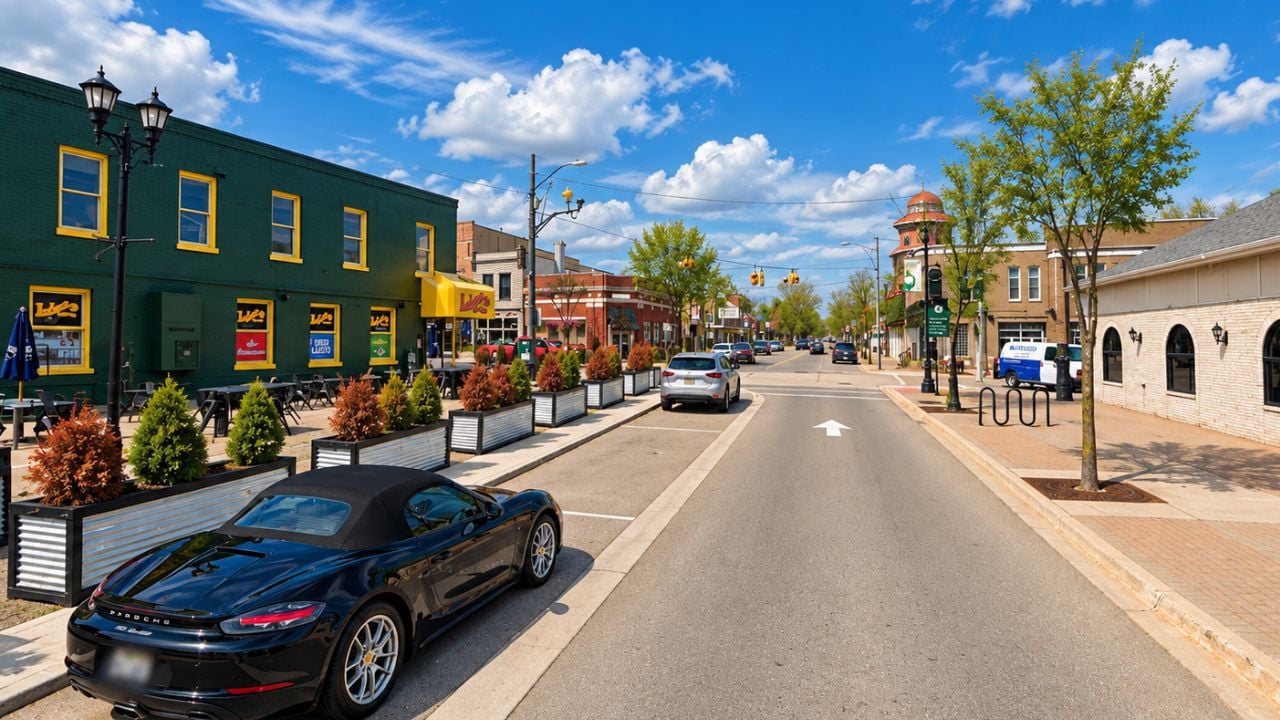
Utica benefits from its location near two major Metro Detroit road corridors: M-59 and M-53.
M-59 provides east-west connections across northern Metro Detroit, while M-53 connects communities throughout Macomb County.
Residents traveling toward Troy, Auburn Hills, Rochester Hills, Warren or other employment centers can use these roads to connect with the regional highway system.
I-75 is accessible farther west, while I-94 is located farther east.
The exact commute depends on your destination, traffic and construction, but Utica generally offers more immediate access to developed suburban road corridors than rural communities farther north in Macomb County.
How Far Is Utica Michigan From Downtown Detroit?
Utica is approximately 25 miles north of Downtown Detroit, depending on the starting point and route.
A drive may take approximately 35 to 50 minutes under favorable conditions, but rush-hour traffic and construction can increase travel times considerably.
If you're planning to commute into Detroit regularly, test the route during the hours you would normally travel.
How Far Is Utica From Troy and Auburn Hills?
Utica is generally within a relatively short drive of Troy and Auburn Hills.
Many destinations in those communities can be reached in approximately 20 to 35 minutes under favorable traffic conditions, although travel times depend on the exact address.
This makes Utica worth considering for buyers who work across multiple parts of northern Metro Detroit.
What Types of Homes Are Available in Utica Michigan?
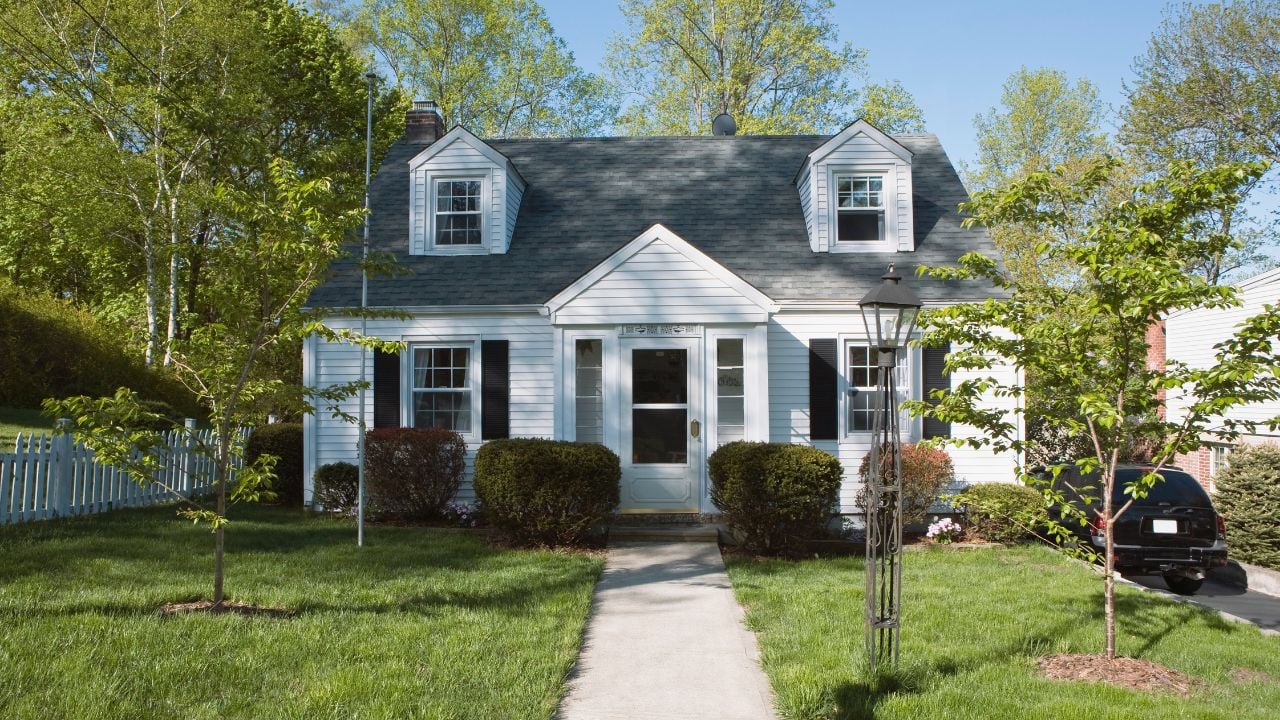
One of the more surprising things about Utica's real estate market is the variety of housing found within such a small city.
Buyers can encounter condominiums, older single-family homes, traditional suburban properties and larger custom homes.
There are also waterfront properties in certain areas.
However, because the city is so small, housing inventory can be limited at any given time.
If you only search within the actual City of Utica boundaries, you may find considerably fewer listings than if you expand into Shelby Township or Sterling Heights.
How Much Do Homes Cost in Utica Michigan?
Based on my local MLS analysis covering the 12 months leading into the late summer of 2026, approximately 101 residential properties sold within the City of Utica.
Those sales ranged from an approximately $75,000 condominium to an $800,000 waterfront property.
As of August 2026, the reported monthly median sale price for Utica was approximately $252,500, compared with approximately $282,500 across the broader MLS market used in the analysis.
These figures reflect a particular reporting period and property mix. They should not be interpreted as a permanent market value or as the expected price of a typical single-family home.
Utica's small number of monthly transactions makes its median particularly sensitive to which homes happen to sell.
Can You Find Affordable Homes in Utica Michigan?
Utica does have housing options at lower price points than some surrounding markets, particularly when condominiums are included.
For example, one of the lowest closed sales in my recent MLS review was a three-bedroom, one-and-a-half-bath condominium built in 1967.
The property contained approximately 950 square feet, had no garage and sold for $75,000.
That example demonstrates that lower-priced opportunities can exist, but it does not mean comparable properties are regularly available at that price.
Condominium buyers should also evaluate association fees, association finances, maintenance responsibilities, insurance coverage and any restrictions affecting the property.
Are There Luxury Homes in Utica Michigan?
Yes. Although Utica is better known as a small suburban city, its housing market includes some higher-end properties.
In the same MLS review, a six-bedroom colonial with approximately 6,100 square feet sold for $800,000.
The home was built in 2005 and included a three-car garage, approximately one-quarter acre of land and frontage on South Golden Lake.
This illustrates how different housing options can exist within the same small municipality.
A condominium and a large waterfront home may share a city name, but they represent completely different segments of the market.
Why Can Utica Home Prices Change So Much From Month to Month?
Small real estate markets can produce misleading headlines when monthly data is viewed without context.
Because Utica has relatively few home sales compared with larger communities, a handful of unusually expensive or inexpensive transactions can noticeably influence the monthly median.
For example, if several condos close during one month, the median could fall even if comparable single-family homes have not lost value.
Conversely, several larger or waterfront transactions could push the median higher without representing a broad increase in every home's value.
When evaluating Utica real estate, I recommend looking at comparable properties, property types, recent closed sales, inventory and longer-term trends instead of relying exclusively on one monthly median.
Utica Community Schools vs the City of Utica
Here is where Utica becomes especially interesting for relocation buyers.
Utica Community Schools covers a much larger geographic area than the City of Utica itself.
The district serves more than 25,000 students across portions of multiple municipalities in Macomb County.
Those communities include Utica, Sterling Heights, Shelby Township, Macomb Township, Washington Township and Ray Township.
As a result, buyers interested in the district do not necessarily need to purchase a home within the actual City of Utica.
This distinction can substantially expand a home search and create opportunities to compare different housing types, municipal services and property tax rates.
What Schools Are in Utica Community Schools?
Utica Community Schools operates elementary, junior high and high school programs across its service area.
The district includes multiple comprehensive high schools, including Utica High School, Eisenhower High School, Stevenson High School and Henry Ford II High School.
It also offers specialized educational programs and alternative learning opportunities.
However, purchasing within the district does not automatically guarantee assignment to whichever individual school you prefer.
Attendance boundaries and enrollment rules determine school placement, and those boundaries can change.
Before buying, confirm the assigned schools directly with Utica Community Schools.
Are Utica Community Schools Highly Rated?
Utica Community Schools is one of the largest school districts in Macomb County and offers a broad range of academic, career-focused and extracurricular programs.
Third-party rating platforms have given the district favorable overall assessments, including an A-minus rating in the research used for this guide.
However, school rankings and ratings change, and different platforms use different methodologies.
Buyers should compare objective information such as graduation rates, academic performance, available programs, school locations and transportation arrangements using district and Michigan Department of Education resources.
Most importantly, verify the actual attendance assignment for the property you are considering.
Can You Live in Shelby Township and Attend Utica Community Schools?
Yes. Portions of Shelby Township are located within Utica Community Schools.
However, not every Shelby Township address necessarily has the same school assignment.
School district boundaries and individual school attendance boundaries should be verified for each property.
This is one reason buyers should search using school district boundaries rather than relying only on city or township names.
Can You Live in Sterling Heights and Attend Utica Community Schools?
Yes. Utica Community Schools serves portions of Sterling Heights.
Sterling Heights also contains areas served by other school districts, so not every Sterling Heights home belongs to Utica Community Schools.
Always verify the specific address before purchasing.
Why Do Property Taxes Vary So Much Around Utica?
Michigan property taxes are determined by a property's taxable value and the millage rates applying to that specific parcel.
Those millages can include municipal, county, school district and other taxing authority levies.
Because Utica Community Schools extends across several different municipalities, buyers can potentially live within the same school district while paying different municipal tax rates.
For example, a property in Macomb Township may have a lower overall principal residence millage rate than a similarly valued property within the City of Utica.
That difference does not necessarily mean the properties receive identical municipal services, and it should not be treated as a school quality comparison.
It does mean that understanding the tax jurisdiction is essential when comparing homes.
Utica Community Schools Property Tax Comparison
Michigan's published 2025 millage data illustrates how property tax rates differ across municipalities within the same school district.
For principal residences in Utica Community Schools, the rates in Macomb Township and other northern townships can be noticeably lower than those in the City of Utica or Sterling Heights.
As one example, the 2025 state report lists Macomb Township's regular principal residence rate for Utica Community Schools at approximately 25.41 mills.
That is substantially different from the higher municipal tax structure in the City of Utica.
Because annual millages, special assessments and parcel-specific circumstances vary, buyers should verify current rates instead of relying on a general comparison alone.
For a property-specific estimate, use the Michigan Department of Treasury Property Tax Estimator.
How Much Could Property Taxes Affect Your Monthly Payment?
Consider two hypothetical homes purchased for $250,000, each with an estimated taxable value of $125,000 after transfer.
At 25.41 mills, the estimated annual tax would be approximately $3,176.
At 40 mills, the estimated annual tax would be approximately $5,000.
That represents a difference of approximately $1,824 annually, or $152 per month.
These are illustrative calculations rather than quotes for particular properties. Actual taxable value, millages, exemptions and special assessments may differ.
Nevertheless, the example demonstrates why two homes with similar purchase prices can have different total ownership costs.
Will My Property Taxes Increase After Buying a Home in Utica?
They can.
Michigan limits many annual taxable value increases while a property remains under the same ownership.
After a qualifying transfer of ownership, taxable value is generally uncapped in the following tax year.
This means the current owner's tax bill may be significantly lower than the amount a new buyer should budget for.
Before making an offer, calculate estimated post-purchase property taxes based on the property's expected taxable value and applicable millages.
What Are the Pros of Living in Utica Michigan?
Utica offers a combination of small-city character and convenient access to a much larger metropolitan area.
Some of the biggest advantages include:
- A compact historic downtown with local businesses
- Access to M-59 and M-53
- Proximity to Shelby Township and Sterling Heights
- Multiple housing types and price points
- Access to the Clinton River corridor
- Local events and community traditions
- Nearby shopping, dining and recreation
- Access to Utica Community Schools for properties within district boundaries
Utica can be especially appealing to buyers who want a smaller municipal environment without moving far away from Metro Detroit's established suburban amenities.
What Are the Cons of Living in Utica Michigan?
Utica also has tradeoffs that are worth understanding before purchasing.
First, the city is extremely small, which means the selection of available homes may be limited at any given time.
Second, many larger shopping centers, parks and entertainment destinations are outside the city limits.
Third, the city has a mix of housing types and ages, so buyers need to evaluate individual properties rather than assume all Utica homes offer similar features.
Finally, municipal property taxes may be higher than those in certain neighboring townships, even when properties are within the same school district.
For buyers prioritizing large lots, extensive subdivision choices or lower municipal millage rates, it may be worth comparing homes in surrounding communities.
Utica vs Shelby Township: Which Should You Choose?
Utica and Shelby Township are closely connected geographically, but they offer different residential environments.
Utica is a compact incorporated city with a recognizable downtown and a relatively limited housing inventory.
Shelby Township is much larger, with numerous subdivisions, commercial areas, parks and housing styles.
Buyers looking for a home close to a traditional downtown may prefer exploring central Utica.
Buyers seeking a broader selection of homes, larger lots or specific subdivision amenities may find more options in Shelby Township.
Both communities contain properties within Utica Community Schools, although school assignments must be verified individually.
Utica vs Sterling Heights: What's the Difference?
Sterling Heights is substantially larger than Utica and contains extensive residential neighborhoods, shopping centers, employment areas and municipal recreation facilities.
Utica offers a smaller downtown-oriented environment with convenient access to those surrounding amenities.
Both locations can work for buyers commuting throughout Macomb County, but housing availability, property taxes and neighborhood characteristics vary.
Rather than choosing based on the city name alone, compare individual properties, school assignments, commute routes and total monthly costs.
Is Utica Michigan a Good Place to Buy a Home?
Utica can be worth considering for buyers who value a compact community, access to downtown businesses and convenient connections to northern Metro Detroit.
However, the city's small size makes property selection especially important.
There may be relatively few comparable homes available at a particular price point, and individual transactions can significantly affect market statistics.
For buyers interested primarily in Utica Community Schools, expanding the search into neighboring municipalities may provide more housing options and different property tax structures.
The best choice depends on the specific home, not simply the name Utica.
What Should You Check Before Buying a Home in Utica?
Before purchasing, verify the following property-specific details:
- Actual municipality and parcel identification
- Assigned school district and individual schools
- Estimated property taxes after transfer
- Homeowners association fees and restrictions, if applicable
- Condominium association financial information, if applicable
- Property condition and major mechanical systems
- Flood risk and insurance considerations near waterways
- Commute times during normal traffic hours
- Parking and road access
- Nearby land uses and future development
These details can make a significant difference in both the cost of ownership and everyday living experience.
Frequently Asked Questions About Living in Utica Michigan
What county is Utica Michigan in?
Utica is located in Macomb County in Southeast Michigan. It is part of the Detroit metropolitan area and is surrounded by communities including Shelby Township and Sterling Heights.
Is Utica Michigan a city or township?
Utica is an incorporated city, not a township. It covers approximately 1.78 square miles. Nearby Shelby Township is a separate municipality.
How many people live in Utica Michigan?
Utica has approximately 5,200 residents. Because the city occupies less than two square miles, its population is much smaller than surrounding communities such as Sterling Heights and Shelby Township.
Is Utica Michigan a good place to live?
Utica offers a small downtown, access to major roads, nearby shopping and recreation, and a variety of housing types. Whether it is a good fit depends on your housing budget, commute, preferred property type and interest in living within a compact city.
What is Utica Michigan known for?
Utica is known for its historic downtown, connection to the Clinton River, local community events and the much larger Utica Community Schools district that shares its name.
Does Utica Michigan have a downtown?
Yes. Downtown Utica is centered around Cass Avenue and Auburn Road. It includes local businesses, restaurants and a traditional downtown streetscape.
Is Downtown Utica Michigan walkable?
The central downtown area is walkable, but walkability from a specific home depends on its location. Many everyday shopping and recreational destinations are located outside the downtown district.
How much do homes cost in Utica Michigan?
In the August 2026 MLS analysis used for this guide, Utica's monthly median sale price was approximately $252,500. The 12-month sales review included properties ranging from a $75,000 condominium to an $800,000 waterfront home. Current prices depend on inventory, property type and market conditions.
Is Utica Michigan expensive to live in?
Housing costs vary by property type, and buyers should account for property taxes, insurance, utilities and association fees when applicable. Some nearby municipalities within Utica Community Schools have lower property tax millage rates than the City of Utica.
What school district is Utica Michigan in?
Utica is served by Utica Community Schools, a large Macomb County district that also serves portions of several neighboring municipalities. Individual school assignments should be verified with the district.
Can you live in Shelby Township and attend Utica Community Schools?
Yes. Portions of Shelby Township are within Utica Community Schools. However, buyers must confirm the school district and individual attendance assignment for the exact property.
Can you live in Sterling Heights and attend Utica Community Schools?
Yes. Portions of Sterling Heights are served by Utica Community Schools. Other portions are served by different districts, so address-specific verification is essential.
Are property taxes higher in Utica than Shelby Township?
They can be. The City of Utica and Shelby Township have different municipal millages, even where properties belong to Utica Community Schools. Actual property taxes depend on taxable value, applicable rates, exemptions and assessments.
Does Utica Michigan have parks and outdoor recreation?
Utica is located along the Clinton River corridor and near several larger recreational destinations in surrounding communities. Dodge Park in Sterling Heights and River Bends Park in Shelby Township are nearby options.
How far is Utica Michigan from Detroit?
Utica is approximately 25 miles north of Downtown Detroit. Driving time varies with traffic, route and construction, but many trips take roughly 35 to 50 minutes under favorable conditions.
Is Utica Michigan close to M-59?
Yes. Utica is located near M-59, also known as Hall Road, and M-53, or Van Dyke. These roads provide connections to nearby communities and the broader Metro Detroit highway network.
Are Utica and Shelby Township the same place?
No. Utica is a separate incorporated city, while Shelby Township is a much larger neighboring municipality. They share geographic connections and portions of the same school district, but they have separate local governments and tax structures.
Should I Buy in Utica or a Surrounding Township?
If you want to live near a compact downtown, Utica may be worth considering. If you want a broader selection of subdivisions, larger properties or different municipal tax rates, Shelby Township, Macomb Township and other nearby areas may offer additional options.
Buyers primarily interested in Utica Community Schools should search by verified school district boundaries rather than limiting their search to the City of Utica.
Final Thoughts on Living in Utica Michigan
Utica may be small, but it occupies an interesting position in northern Metro Detroit.
It has a downtown with a long history, convenient access to major suburban roads, and proximity to some of Macomb County's busiest commercial areas.
At the same time, it is important to understand what Utica is not.
It is not a sprawling suburb with endless subdivisions. It is not a community where every major amenity is located within city limits. And living within Utica Community Schools does not necessarily mean living in the City of Utica.
That last distinction is especially important because your municipality can significantly influence property taxes and housing options.
If you're comparing Utica with Shelby Township, Sterling Heights or other nearby communities, look beyond the mailing address and compare the actual properties, school boundaries, municipal services and estimated ownership costs.
Thinking About Moving to Utica Michigan?
I'm Andrew McManamon with Living in Michigan, and I help buyers, sellers and people relocating throughout Metro Detroit and Southeast Michigan understand the communities, housing markets and costs behind the listings.
If you're considering moving to Utica, Shelby Township, Sterling Heights or anywhere else in Michigan, feel free to reach out.
You can also download my free 74-page Living in Michigan Relocation Guide, which covers Michigan housing, property taxes, cost of living, school districts and what to consider before choosing a community.
For more local insights, housing market updates and community guides, subscribe to the Living in Michigan newsletter.

Check Out the EXCLUSIVE "Living In Michigan" Apparel HERE
Living in Utica Michigan: What You Need to …
Discover what it's like living in Utica,…
Living in Rose, Springfield & Tyrone Townships Michigan: …
Discover what it’s like living in Rose,…

Moving to Metro Detroit? 15 Things Nobody Tells …
Thinking about moving to Metro Detroit? Learn…