55+ Communities in Southeast Michigan: What the Homes Actually Cost, Where to Find Them, and What Nobody Tells You
Finding a 55+ community in Southeast Michigan should be relatively simple, right? You want a home with fewer stairs, less maintenance, maybe a clubhouse, some neighbors to socialize with, and ideally a monthly payment that doesn't require selling a kidney.
Then you start looking.
One community has affordable condos but they're barely 900 square feet. Another has the perfect ranch floor plan but costs half a million dollars. A third looks like a great deal until you discover the monthly association fee is approaching $700.
And when you finally find the right community? There might not be a single home available.
Whether you're planning your own move or helping a parent explore housing options, my goal is to give you a much clearer picture of what's available before you spend months searching.
I Analyzed Nearly $419 Million in 55+ Community Real Estate Activity
Let's start with the research, because the numbers explain why finding the right home can be so difficult.
I reviewed Realcomp MLS listings from early 2017 through October 2026 that were associated with age-restricted communities in Southeast Michigan.
The search returned 2,595 listings, including 1,967 closed sales, representing approximately $419 million in recorded sales volume.
This is not a complete census of every age-restricted home in Michigan. MLS data depends on how listing agents identify properties, and some communities or transactions may be missing. Others may have been categorized incorrectly. I also included two communities marketed as 50-plus rather than 55-plus: Helfer Leisure Co-op and South Pointe.
That distinction matters. These figures describe the properties captured in my MLS research, not every qualifying community or every private transaction in the region.
| Research metric | Result |
|---|---|
| MLS listings reviewed | 2,595 |
| Closed sales | 1,967 |
| Recorded sales volume | Approximately $419 million |
| Median time to sell | 17 days |
| Sold within 14 days | 47% |
| Sold within 30 days | 63% |
| Typical home size | Approximately 1,000 sq. ft. |
| Single-level layouts | Approximately 90% |
Here's what stands out: almost half of the homes sold were under 1,000 square feet, and roughly six out of ten sales closed below $200,000.
At first glance, that sounds like an abundance of affordable retirement housing. But there's an important catch. Many of those lower-priced homes are older, smaller, or structured as cooperative housing, which works differently from purchasing a conventional condominium.
The newer ranch-style communities that buyers often picture when they think of active adult living can cost substantially more.
Where the 55+ Homes Are Actually Selling
The market isn't evenly distributed across Southeast Michigan. In my research, Oakland and Wayne counties accounted for the overwhelming majority of recorded closed sales.
| County | Closed sales in research |
|---|---|
| Oakland | 885 |
| Wayne | 667 |
| Livingston | 191 |
| Genesee | 138 |
| Macomb | 43 |
| St. Clair | 39 |
| Other locations | 4 |
These numbers tell you where the recorded activity was concentrated, but they don't necessarily mean one county is better for retirement than another. Some counties simply have more communities represented in this particular dataset.
If you're searching near family in Oakland or Wayne County, you may have more options to compare. If you're looking in Macomb or St. Clair County, your search may require a little more flexibility around location, ownership type, or age restrictions.
That's why I recommend starting with your actual housing needs rather than limiting your search to one city.
What Can You Buy for $100,000, $200,000, $350,000 or More?
Let's get to the part everybody wants to know: what does the money actually buy?
Across the 1,967 closed sales, here's how the prices were distributed.
| Historical sale price | Number of sales |
|---|---|
| Under $100,000 | 502 |
| $100,000 to under $200,000 | 641 |
| $200,000 to $350,000 | 466 |
| Over $350,000 | 358 |
Nearly 58% of the recorded sales were below $200,000. But before you assume there are hundreds of inexpensive homes available today, remember that these figures combine sales from almost ten years.
A home that sold for $100,000 in 2017 may cost considerably more today. Some of the communities in my research experienced substantial price increases between 2017 and 2026.
Instead of treating these numbers as current asking prices, use them to understand how communities compare with one another.
The More Affordable Communities: Smaller Homes, Co-ops, and Established Developments
Some of the most frequently traded age-restricted properties in Southeast Michigan are in established communities that have been around for decades.
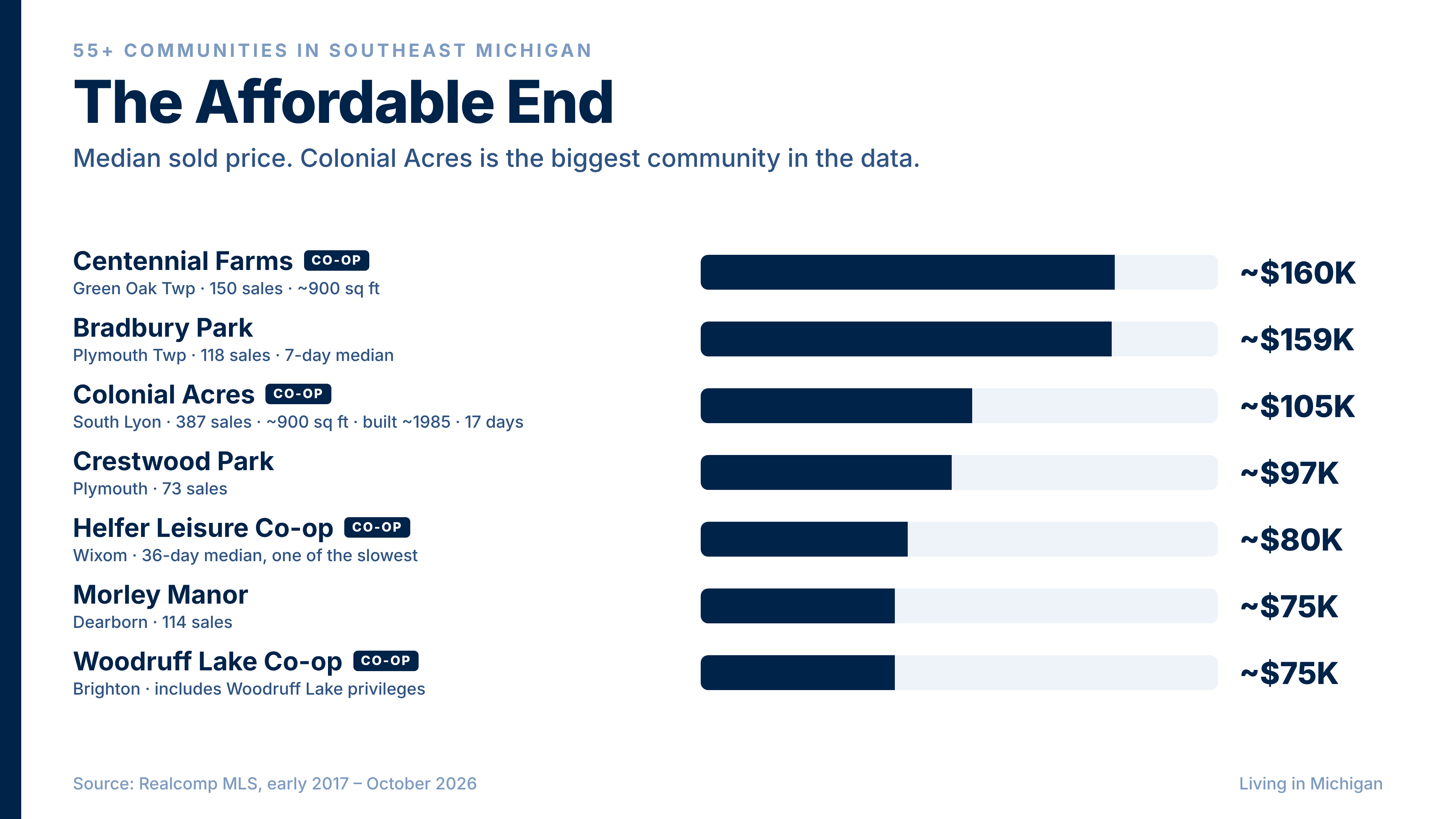
Colonial Acres in South Lyon recorded 387 sales in my dataset, making it the most active community represented. Its historical median sale price was approximately $105,000, with homes around 900 square feet.
Centennial Farms in Green Oak Township recorded 150 sales, with a historical median around $160,000. Bradbury Park in Plymouth Township recorded 118 sales, with a median around $159,000 and a median selling time of seven days.
Morley Manor in Dearborn had 114 sales at approximately $75,000, while Crestwood Park in Plymouth recorded 73 sales around $97,000.
Helfer Leisure Co-op in Wixom and Woodruff Lake Co-op in Brighton also appeared among the lower-priced options. Woodruff Lake Co-op is notable for its lake privileges, while Helfer Leisure had a longer historical median selling time of approximately 36 days.
But here's the important part: a low purchase price doesn't automatically mean a low cost of living.
Some of these properties have substantial monthly charges. Others involve cooperative ownership instead of traditional condominium ownership. And some are upper-level units that require stairs.
In fact, 114 sales in the research involved upper-level units, including 41 at Crestwood Park and 25 at Morley Manor.
So if you're specifically searching for a home without stairs, don't assume an age-restricted listing automatically checks that box.
Why a $75,000 Co-op Isn't the Same as a $75,000 Condo
This is one of the most important distinctions in the entire guide, especially for buyers moving to Michigan from another state.
In a traditional condominium, you generally own a unit or a defined real property interest along with rights in the common elements, subject to the condominium documents.
In a housing cooperative, you're generally purchasing shares or a membership interest in an entity that owns the property. Those shares provide occupancy rights to a particular unit under the cooperative's governing documents.
That difference affects financing, taxes, monthly charges, resale procedures, and sometimes buyer approval.
Several of the lower-priced communities in my research were co-ops, including Colonial Acres, Centennial Farms, Helfer Leisure Co-op, and Woodruff Lake Co-op.
In the transactions I reviewed, cooperative purchases were generally made with cash. That doesn't prove financing is impossible, but it means you should verify acceptable financing directly with the cooperative and an experienced lender before assuming you can use a conventional mortgage.
Monthly cooperative charges can also include expenses that a traditional condo owner might pay separately, such as property taxes, insurance, maintenance, utilities, or debt associated with the cooperative.
Before purchasing, request the cooperative's financial statements, bylaws, occupancy agreement, reserve information, financing requirements, and any available details about underlying debt or planned assessments.
Don't judge a cooperative by its asking price alone. Judge it by the total financial commitment and whether its ownership structure works for your plans.
The Middle Ground: Communities With More Conventional Condo Options
For buyers who want something between a compact cooperative and a higher-priced new construction home, several communities fall into a more moderate historical price range.
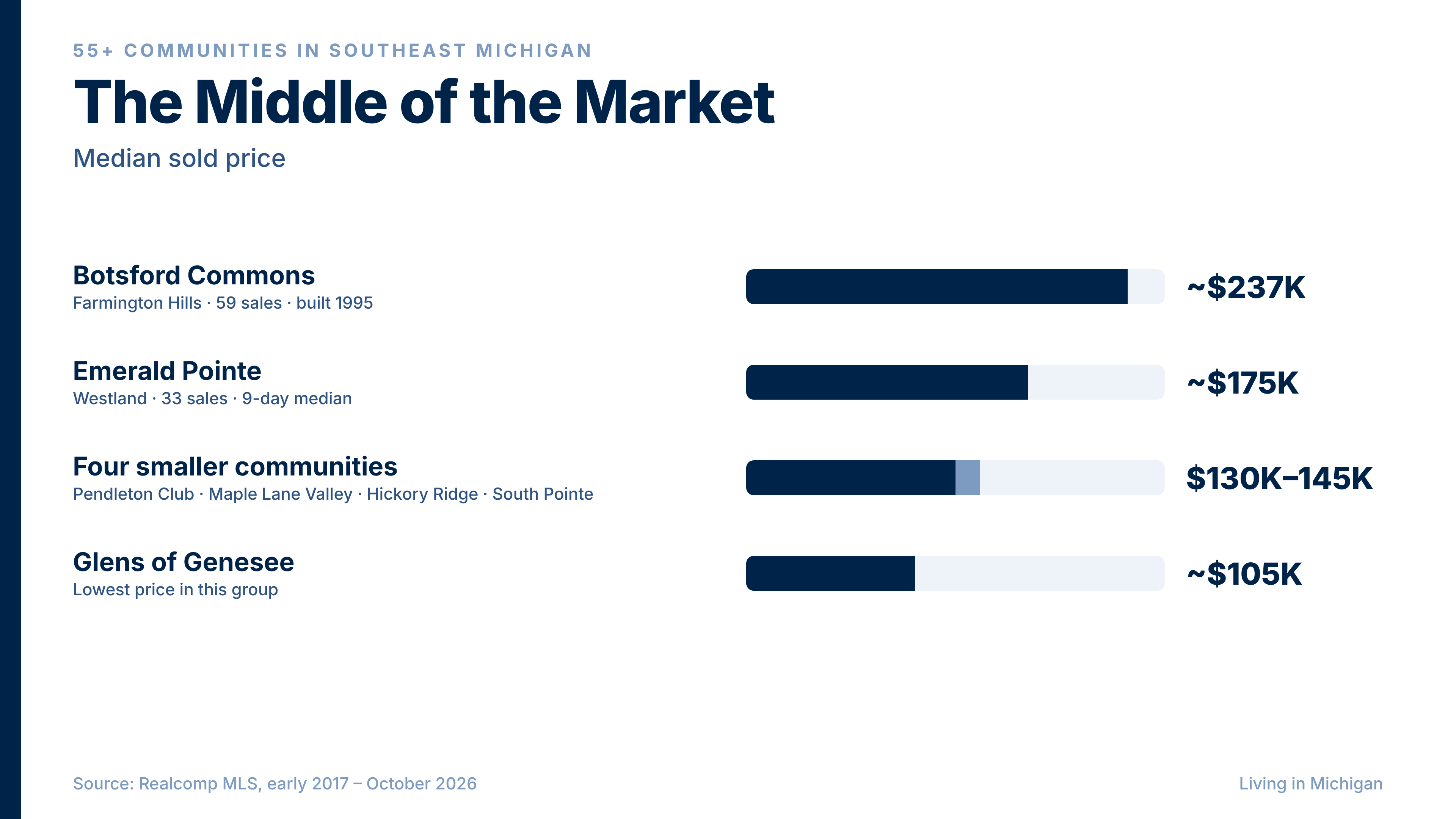
Botsford Commons in Farmington Hills recorded 59 sales with a median price around $237,000. Emerald Pointe in Westland recorded 33 sales around $175,000, with a median of nine days on the market.
Pendleton Club in Farmington Hills, Maple Lane Valley in Warren, Hickory Ridge in Dearborn Heights, and South Pointe in Novi also appeared in the research, with historical median prices generally between $130,000 and $145,000.
Glens of Genesee appeared at approximately $105,000.
These communities may be worth comparing if you're trying to balance purchase price, floor plan, location, and maintenance responsibilities. However, the age requirements, ownership structures, available amenities, and association rules are not necessarily identical.
For each community, verify whether it is truly age-restricted, what the association maintains, whether there are stairs, and whether the particular unit fits your accessibility needs.
Where Buyers Find Larger Ranch-Style Homes and More Modern Floor Plans
Now we're getting closer to what many people picture when they search for a 55+ community: a newer ranch-style home, a more open layout, a garage, and fewer maintenance responsibilities.
Bridgewater Park in Brownstown Township recorded 173 sales in my research, with a historical median around $314,000 and homes averaging roughly 1,935 square feet.
Grand Reserve and the Townes at Grand Reserve in Grand Blanc recorded a combined 115 sales, with a historical median around $330,000.
Crystal Village in Canton recorded 59 sales, with a historical median around $340,000 and homes around 1,725 square feet. Its median selling time was approximately ten days.
The Villas at Maple Creek in Canton recorded 24 sales, with a historical median around $262,000.
In Auburn Hills, Heritage in the Hills recorded 90 sales with a median around $364,500, while Reserves of Auburn Hills recorded 73 sales around $371,000.
These are not interchangeable communities. Some may offer more extensive amenities, different building types, or different maintenance arrangements. But they illustrate the segment of the market where buyers may find more of the larger, single-level layouts they're imagining.
And because these prices cover multiple years, you should not use them as current listing quotes. For example, the research showed Crystal Village's median moving from roughly $310,000 in 2017 to $421,000 in 2025.
That's a meaningful difference if you're setting your budget today.
The Premium End: When 55+ Housing Costs $500,000 to Over $1 Million+
At the higher end of the market, the numbers change considerably.
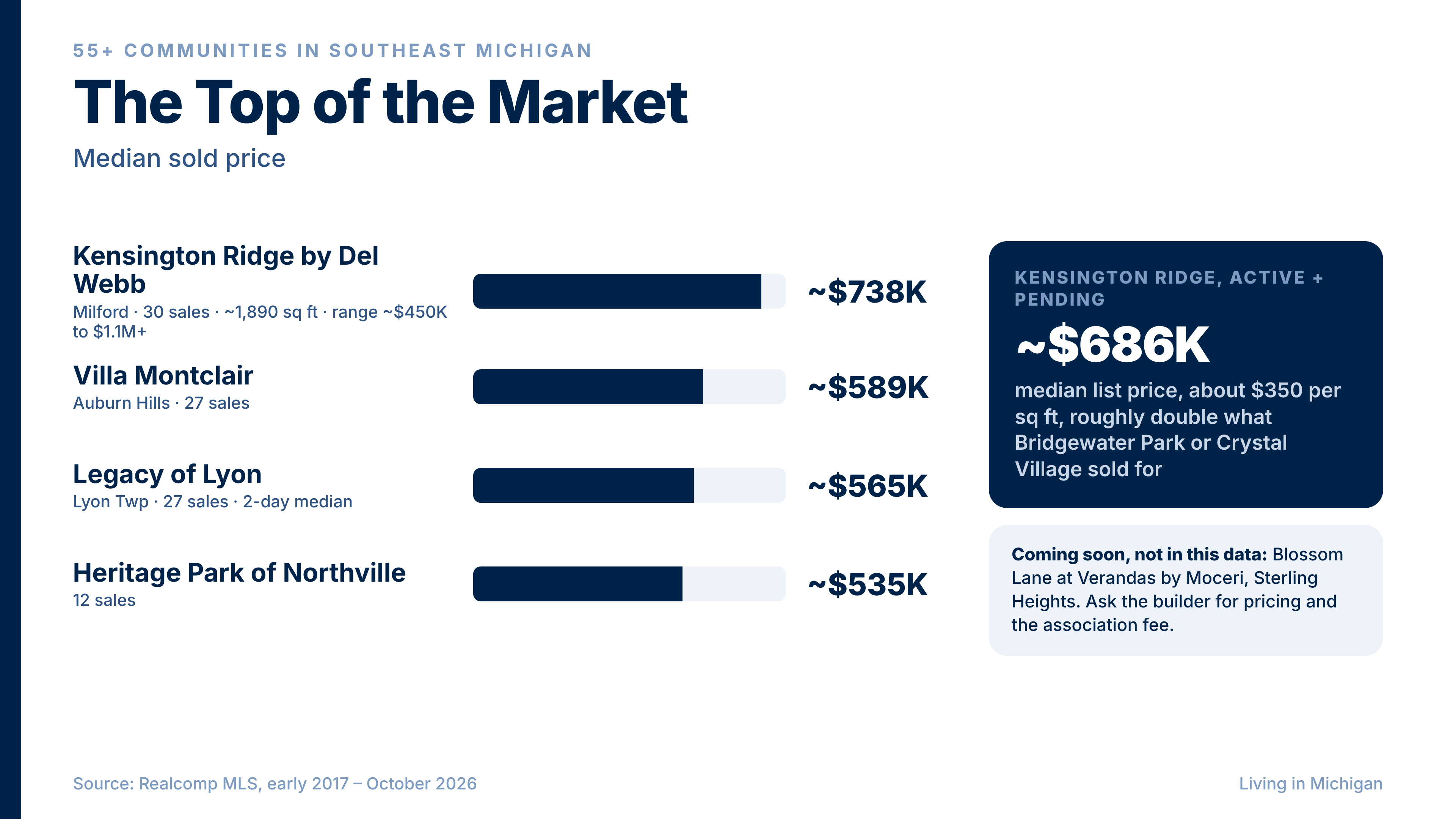
Villa Montclair in Auburn Hills recorded 27 sales with a historical median around $589,000. Legacy of Lyon in Lyon Township recorded 27 sales around $565,000, with a remarkably short two-day median selling time.
Heritage Park of Northville recorded 12 sales around $535,000.
Then there's Kensington Ridge by Del Webb in Milford.
My research captured 30 sales at Kensington Ridge, with a median around $738,000. Recorded sale prices ranged from approximately $450,000 to more than $1.1 million.
At the time of my October 2026 research, the active and pending listings at Kensington Ridge had a median asking price around $686,000.
There's clearly a market for newer, higher-priced active adult housing. But there's also a substantial gap between someone who can spend $175,000 and someone who can spend $700,000.
And that gap matters when you're trying to find a comfortable, low-maintenance home that will work for the next 10 or 20 years.
Blossom Lane at Verandas by Moceri in Sterling Heights was also identified as a forthcoming community during the research period, but it had no qualifying closed sales in my dataset. Buyers interested in it should contact the builder for current availability, pricing, age requirements, and association details.
Compare Southeast Michigan's 55+ Communities in One Place
The table below summarizes selected communities from the MLS research. Prices represent median closed sales recorded between early 2017 and October 2026, not current asking prices or appraised values.
| Community | Location | Historical median sale price | Recorded sales |
|---|---|---|---|
| Morley Manor | Dearborn | $75,000 | 114 |
| Helfer Leisure Co-op* | Wixom | $80,000 | Research sample |
| Crestwood Park | Plymouth | $97,000 | 73 |
| Colonial Acres | South Lyon | $105,000 | 387 |
| Centennial Farms | Green Oak Township | $160,000 | 150 |
| Bradbury Park | Plymouth Township | $159,000 | 118 |
| Emerald Pointe | Westland | $175,000 | 33 |
| Botsford Commons | Farmington Hills | $237,000 | 59 |
| Villas at Maple Creek | Canton | $262,000 | 24 |
| Bridgewater Park | Brownstown Township | $314,000 | 173 |
| Grand Reserve / Townes | Grand Blanc | $330,000 | 115 combined |
| Crystal Village | Canton | $340,000 | 59 |
| Heritage in the Hills | Auburn Hills | $364,500 | 90 |
| Reserves of Auburn Hills | Auburn Hills | $371,000 | 73 |
| Heritage Park of Northville | Northville area | $535,000 | 12 |
| Legacy of Lyon | Lyon Township | $565,000 | 27 |
| Villa Montclair | Auburn Hills | $589,000 | 27 |
| Kensington Ridge | Milford area | $738,000 | 30 |
*Helfer Leisure Co-op was included in the research despite being identified as a 50-plus community. Not all communities have the same legal age restrictions. The table includes selected communities, not every community in the dataset. Confirm community names, location, current pricing, and eligibility before purchasing.
The Monthly Fee Can Change Everything
Here's a scenario that comes up all the time.
You find a condo listed for $110,000. Another is listed for $190,000. You assume the first one is the more affordable option.
But the first has a $600 monthly association charge, while the second has a $250 charge.
That's a $350 monthly difference, or $4,200 per year, before considering differences in what the fees actually cover.
Over ten years, that difference would total $42,000 if fees never changed. In reality, association charges can increase, and special assessments may create additional expenses.
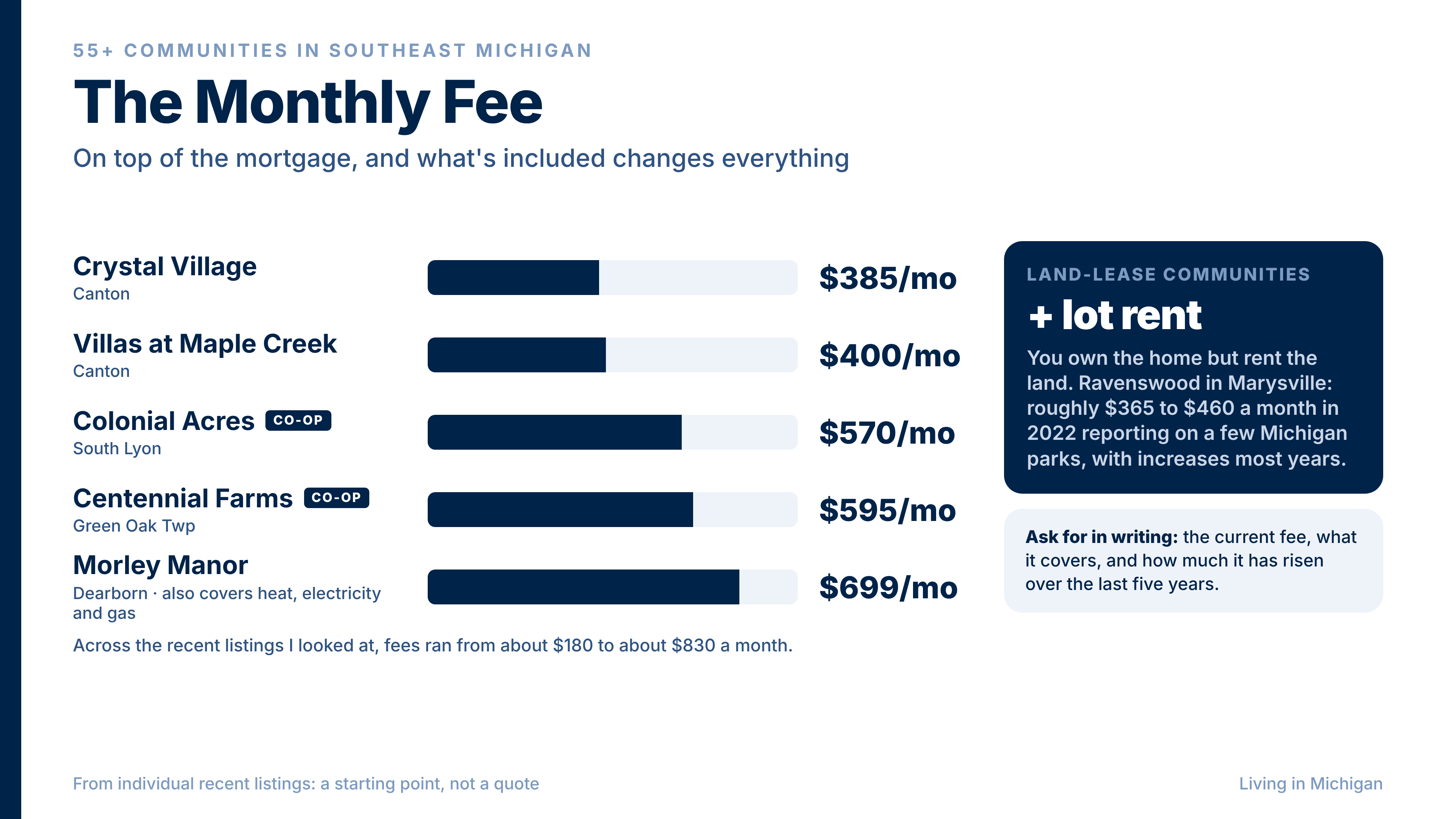
Recent listing examples in my October 2026 research showed monthly charges around $385 at Crystal Village, $400 at Villas at Maple Creek, $570 at Colonial Acres, $595 at Centennial Farms, and $699 at Morley Manor. The Morley Manor example included heat, electricity, and gas.
These were listing-level examples, not verified current community-wide fee schedules. They also cannot be compared fairly without reviewing what each fee includes.
A $600 monthly charge covering property taxes, utilities, exterior maintenance, and insurance may be very different from a $300 charge that excludes all of those expenses.
Before you buy, request the current fee in writing and review the association budget, reserve study if available, financial statements, and recent meeting minutes.
Use This Formula to Compare the True Monthly Cost
Instead of comparing purchase prices alone, calculate the total monthly ownership cost.
Total monthly housing cost = mortgage principal and interest + property taxes + insurance + association or cooperative fees + utilities + expected maintenance + any applicable lot rent.
Here's a simplified comparison of two hypothetical properties. These are examples, not actual listings.
| Expense | Home A | Home B |
|---|---|---|
| Purchase price | $125,000 | $225,000 |
| Monthly association fee | $600 | $275 |
| Annual association fees | $7,200 | $3,300 |
| 10-year fees, unchanged | $72,000 | $33,000 |
Home A costs $100,000 less upfront but has $39,000 more in association fees over ten years if those fees remain unchanged.
That doesn't automatically make Home B the better financial choice. Financing costs, property taxes, insurance, utilities, resale value, maintenance coverage, and available cash all affect the outcome.
The lesson is simple: compare the complete ownership cost, not just the listing price.
One-Level Living Isn't Always No-Step Living
One of the most interesting findings in the research involves floor plans.
In a comparison sample of approximately 5,000 conventional home sales from the same counties, around 48% had single-level layouts. In the age-restricted community dataset, approximately 90% were single-level.
That's a meaningful difference for anyone looking to reduce stairs.
But there's a catch. A home described as single-level can still be located upstairs, have steps at the entry, or include features that become difficult to use over time.
And size matters, too.
The median conventional home in the comparison sample was around 1,460 square feet. In the 55+ community research, the median was approximately 1,000 square feet.
That might be perfect if you're downsizing. But if you want a home office, guest bedroom, hobby room, or space for visiting relatives, 900 square feet can feel a lot smaller once you're actually living in it.
When touring homes, pay attention to the entry, hallways, door widths, bathrooms, laundry location, parking, and whether everyday activities require using stairs.
Think about the home you need today, but also the home you'll want to live in ten or fifteen years from now.
Should You Choose a 55+ Community, a Regular Condo, or Independent Living?
This is where I think the conversation needs to go beyond real estate prices.
Before becoming a Realtor, I worked as a manager in senior living. That experience gave me a very different perspective on how people approach their next housing decision.
Some residents loved the activities, social connections, and convenience of having services available. Others preferred more privacy and independence. Neither preference was wrong.
And that's exactly why I don't think everybody should automatically choose a 55+ community just because they've reached a certain age.
An age-restricted community is generally a housing arrangement with age-related occupancy rules. It doesn't automatically include meals, transportation, personal care, or medical services.
A conventional condominium may offer similar low-maintenance living without age restrictions.
Independent living communities may offer housing together with amenities or services such as meals, housekeeping, transportation, and organized activities, depending on the operator.
Assisted living is a different arrangement, generally involving additional personal care or supportive services.
The best option depends on how much independence you want, which services you need, what kind of social environment you prefer, and what you can comfortably afford.
For some buyers, owning a ranch condo and choosing their own activities is ideal. For others, a community with organized events and services may be worth the added cost.
It's not about which option is universally better. It's about choosing the right arrangement for your actual lifestyle.
What I Would Ask Before Buying in Any 55+ Community
After working with buyers in these communities, I've learned that the questions people don't ask are often the ones that matter most later.
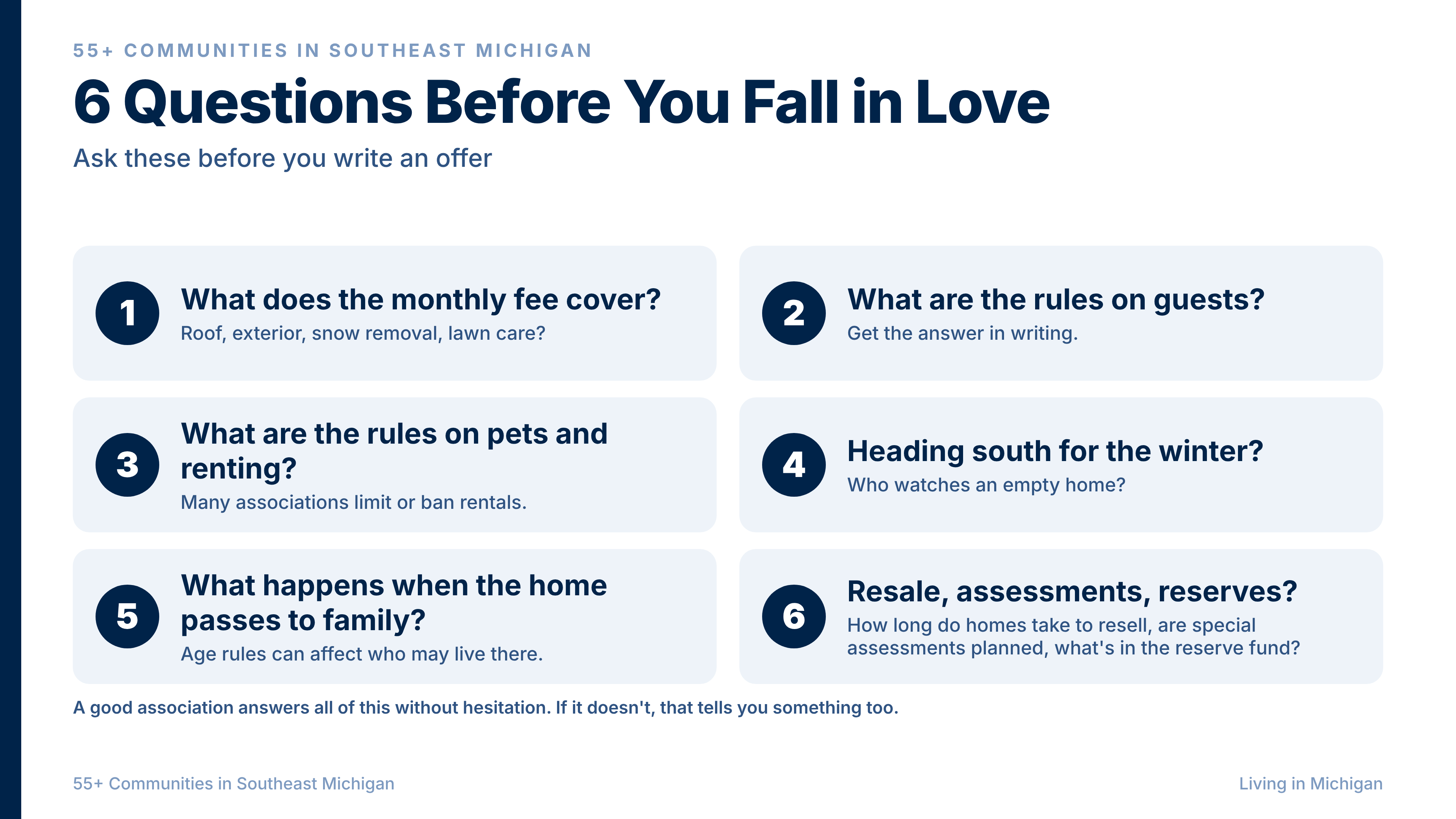
Start with the financials. Ask what the monthly fee includes, whether the association has adequate reserves, whether any special assessments are planned, and how much the fees have increased over the past five years.
Then review the ownership rules. Confirm whether you're purchasing a condominium, cooperative interest, manufactured home, or another form of ownership. Ask about financing, resale approvals, transfer fees, and any restrictions that could affect future plans.
Next, think about everyday living. Are pets permitted? Can guests stay for extended visits? Are rentals allowed? Who handles snow removal? What happens if you're away for several months?
Finally, plan for the future. What happens if an owner dies and a younger spouse or family member remains? Can the property be inherited? What are the occupancy requirements? And if you need to sell, how frequently do homes become available in that particular community?
Get the answers from the current governing documents and appropriate professionals, not simply from an online listing description.
Why Finding the Right Home Can Take Longer Than You Expect
In 2020, my dataset recorded 284 closed sales. That fell to 206 in 2022, 157 in 2023, 150 in 2024, and 145 in 2025.
Through October 2026, the research captured 93 closed sales.
Those figures show declining recorded transaction volume, although they don't prove that limited supply is the only cause. Demand, prices, market conditions, and changes in how listings are entered can also influence the totals.
At the time of the October 2026 data pull, just 58 properties in the research set were active or pending, and 20 of those were associated with Kensington Ridge.
That gives you an idea of how limited the selection can be when you're searching for a specific type of home.
Interestingly, the median age-restricted home in the research took 17 days to sell, compared with eight days for the conventional home comparison sample. So it wouldn't be accurate to say every 55+ home sells faster than a regular home.
What can move very quickly is a particular combination of price, condition, location, and floor plan.
Legacy of Lyon, for example, had a two-day historical median selling time in the research. Crystal Village had a ten-day median.
If you have your heart set on a specific community, it helps to have financing or proof of funds prepared, understand the ownership requirements, and monitor new listings closely.
In some situations, I also reach out to owners who may be considering selling, rather than waiting for the perfect listing to appear online.
My Advice for Buyers Relocating From Florida, Arizona, or Another State
If you're relocating from a state with a large active adult housing market, Southeast Michigan may feel a little different.
You may be accustomed to communities with extensive amenities, multiple floor plans, and a steady supply of resale homes. Here, some of the most appealing communities have very limited turnover.
Start your search earlier than you think you need to, particularly if you're only interested in one or two developments.
Also, don't overlook a conventional ranch condominium simply because it isn't marketed as a 55+ community. You may find the layout and maintenance arrangement you're looking for without needing an age-restricted development.
Just remember that a traditional condo won't necessarily offer the same community programming, social opportunities, or age-related occupancy rules.
And if you're purchasing from out of state, request the governing documents before traveling for a showing whenever possible. There is no reason to fly to Michigan to tour a property only to discover afterward that the financing structure, pet policy, or monthly fees don't work for you.
Free Resources for Planning Your Next Move
I've put together a free 55+ Communities in Southeast Michigan Guide based on the research in this article HERE
It includes the communities identified in my MLS data, historical pricing information, questions to bring on tours, a budget checklist, and resources to help you research your next move.
It also comes with my free 74-page Michigan Relocation Guide, which covers important considerations for moving to the state.
For additional planning help, the following official resources are useful:
Medicare.gov: Long-Term Care Coverage explains what Medicare generally does and does not cover.
Michigan's MI Choice Waiver Program explains certain home and community-based services available to eligible Medicaid participants.
Eldercare Locator helps connect people with aging-related services and resources.
These resources can be useful whether you're purchasing an age-restricted condo, considering independent living, or helping a family member plan for future support needs.
Frequently Asked Questions About 55+ Communities in Southeast Michigan
What are the most affordable 55+ communities in Southeast Michigan?
In my Realcomp MLS research covering early 2017 through October 2026, lower-priced historical sales appeared in communities such as Morley Manor in Dearborn, Crestwood Park in Plymouth, Colonial Acres in South Lyon, and Centennial Farms in Green Oak Township. However, those figures are historical medians, not current asking prices. Some of these communities also use cooperative ownership, which can affect financing and monthly costs.
Can you live in a 55+ community if you're under 55?
Sometimes, depending on the community's rules. Under the federal Housing for Older Persons Act framework, qualifying 55-and-older housing generally must have at least one occupant aged 55 or older in at least 80% of occupied units, along with other requirements. This does not mean every community must admit younger residents. Communities may adopt more restrictive occupancy rules, subject to applicable law. Always review the specific community's policies. Source: 24 CFR 100.305 and HUD guidance.
Can my children or grandchildren visit a 55+ community?
Guest and occupancy policies depend on the community's governing documents. Federal rules governing qualifying housing for older persons do not create one universal guest policy for every development. Ask about overnight visits, extended stays, and whether any restrictions apply to guests of different ages. Source: HUD housing-for-older-persons guidance.
Do you have to be retired to buy a home in a 55+ community?
Not necessarily. The federal 55-and-older housing exemption is based on age-related occupancy requirements, not employment or retirement status. Individual community rules and purchase qualifications may vary. Source: 24 CFR 100.305.
What's the difference between a 55+ community and assisted living?
A 55+ community is generally a residential development with age-related occupancy restrictions. It does not automatically provide personal care or medical services. Assisted living arrangements generally provide housing with additional supportive or personal care services, depending on the facility and applicable regulations. Buyers should evaluate the actual services offered rather than assuming all retirement housing operates the same way.
Does Medicare pay for living in a 55+ community?
Medicare does not generally pay for purchasing a home, condominium fees, or ordinary housing costs. Medicare also generally does not cover long-term custodial care, although it may cover certain qualifying medical or skilled services. Source: Medicare.gov.
Are 55+ communities cheaper than assisted living?
They have different cost structures and provide different services, so a simple price comparison can be misleading. Owning a condo involves purchase costs, taxes, insurance, association fees, utilities, and maintenance. Assisted living typically involves recurring charges for housing and varying levels of services. Compare the complete costs and services for your specific needs.
Are there 55+ ranch condos in Oakland County Michigan?
Yes. Communities appearing in my research include Heritage in the Hills, Reserves of Auburn Hills, Villa Montclair, Botsford Commons, and Legacy of Lyon. Individual floor plans and age restrictions must be verified, and availability changes frequently.
Are there 55+ communities near Ann Arbor or Brighton Michigan?
The research identified communities in Livingston County, including Centennial Farms in Green Oak Township and Woodruff Lake Co-op in Brighton. Buyers seeking proximity to Ann Arbor should also compare location, commute times, and current inventory rather than assuming every nearby community has available homes.
What is the difference between a condo and a co-op in Michigan?
Condominium ownership generally involves an individually owned real property interest governed by condominium documents. Cooperative housing generally involves shares or membership in an entity that owns the property, with occupancy rights tied to that interest. Financing, taxes, resale approval, and maintenance responsibilities can differ. Have the applicable documents reviewed before purchasing.
Can you get a mortgage on a 55+ cooperative in Michigan?
Financing availability depends on the cooperative's structure, governing documents, and lender requirements. The cooperative sales reviewed for this article were generally cash transactions. Ask the cooperative and a lender experienced with cooperative housing whether financing is available before making an offer.
How much are HOA fees in Southeast Michigan 55+ communities?
Fees vary widely. Individual listing examples in my October 2026 research ranged from approximately $180 to $830 per month. Some include exterior maintenance, snow removal, utilities, insurance, or other expenses, while others provide fewer services. Always request the current fee and an itemized explanation of what it covers.
Can you rent out a home in a 55+ community?
That depends on the governing documents. Some communities allow rentals under specified conditions, while others restrict or prohibit them. Age-related occupancy rules may also apply to tenants. Review rental restrictions before purchasing, particularly if you might keep the property as an investment later.
What happens if I inherit a home in a 55+ community and I'm under 55?
Inheriting ownership does not necessarily mean you can occupy the home regardless of age. The outcome depends on the community's documents, applicable law, and the circumstances of the inheritance. Review the governing documents and obtain legal advice before relying on a future inheritance or occupancy plan. Source: HUD guidance on housing for older persons.
Does Michigan offer help for older adults who want to remain in their homes?
Yes, certain programs may help eligible residents access services. Michigan's MI Choice Waiver Program allows qualifying Medicaid participants who meet applicable eligibility requirements to receive certain home and community-based services rather than nursing facility care. Available services can include community living supports, home-delivered meals, accessibility adaptations, and transportation. Source: Michigan Department of Health and Human Services.
How do I find available 55+ homes for sale in Southeast Michigan?
Start with a property search that includes age restrictions, housing type, location, and your preferred layout. Because MLS age-restriction fields are not always completed consistently, confirm eligibility directly with each community. If you are focused on a particular development, setting up listing alerts and monitoring resale activity can help you identify opportunities when homes become available.
Finding the Right Community Is About More Than Finding the Right House
After going through almost ten years of sales data, here's what stands out to me.
Southeast Michigan has some excellent age-restricted housing options. But the selection is limited, the pricing varies dramatically, and the homes that offer the right combination of layout, condition, and affordability can be difficult to find.
That's especially true if you're looking for a newer ranch-style home, reasonable monthly fees, and enough space to enjoy the next chapter of your life.
I've helped buyers navigate cooperative purchases, search for homes in communities with little inventory, and compare traditional condos with other housing options. And because I worked in senior living before becoming a Realtor, I understand that this decision is about much more than square footage.
It's about independence, convenience, finances, community, and what you want everyday life to look like.
If you're exploring 55+ communities in Southeast Michigan for yourself or someone in your family, reach out. I'd be happy to help you compare communities, understand the costs, and find options that make sense for your plans.
You can also get my free 55+ Communities in Southeast Michigan Guide and 74-page Michigan Relocation Guide to help you get started.
Research note: All MLS figures in this article are based on the author's Realcomp research covering early 2017 through October 2026. Historical sale prices, days on market, and association fee examples are not current offers or guarantees. Community eligibility, availability, financial requirements, and amenities must be independently verified.

Check Out the EXCLUSIVE "Living In Michigan" Apparel HERE
Living in Madison Heights Michigan: Homes, Taxes, Schools …
Madison Heights might be one of Metro…
Living in Pleasant Ridge Michigan: The Tiny City …
Discover what makes Pleasant Ridge, Michigan unique,…