
Imagine buying a beautiful detached home in Michigan. You've got your own driveway, a two-car garage, a green lawn, and absolutely no shared walls. It looks like a regular house, feels like a regular house, and costs about what you'd expect a regular house to cost.
Then the condominium bylaws arrive in your inbox.
Wait. Condominium bylaws? You thought you were buying a house.
Welcome to Michigan real estate, where even a detached home with its own yard can legally be a condominium.
And that's only the beginning. The property taxes advertised on the listing might be significantly lower than what you'll pay after purchasing. Your association could be responsible for maintaining the roof, or you might be responsible for every single shingle. Your monthly HOA fee could cover nearly everything, or it could cover a private road and a few patches of grass.
None of this means buying a condo in Michigan is a bad idea. In fact, condos can be an excellent option for people looking to simplify their lifestyle, downsize, reduce exterior maintenance, or enjoy a particular community.
But the details matter. A lot.
I'm Andrew McManamon, a Michigan Realtor and creator of Living in Michigan. I've helped buyers navigate traditional condos, detached site condos, and age-restricted communities throughout Southeast Michigan. Here are ten things I'd want you to understand before writing an offer.
1. A Detached House in Michigan Can Legally Be a Condominium
Let's clear up one of the biggest misconceptions right away. A condominium is a form of property ownership, not necessarily a type of building.
Most people picture condos as apartments stacked on top of one another, with shared hallways, elevators, and neighbors on the other side of the wall. Those certainly exist, but Michigan also has detached site condominiums that look almost identical to traditional single-family homes.
You might have your own front porch, backyard, basement, garage, and driveway, with no shared walls whatsoever. Legally, however, the property is part of a condominium development.
Under Michigan's Condominium Act, a condominium project is established through recorded documents, including a master deed, bylaws, and condominium subdivision plan.
The important question isn't whether the property looks like a condo. It's what the legal documents say you actually own.
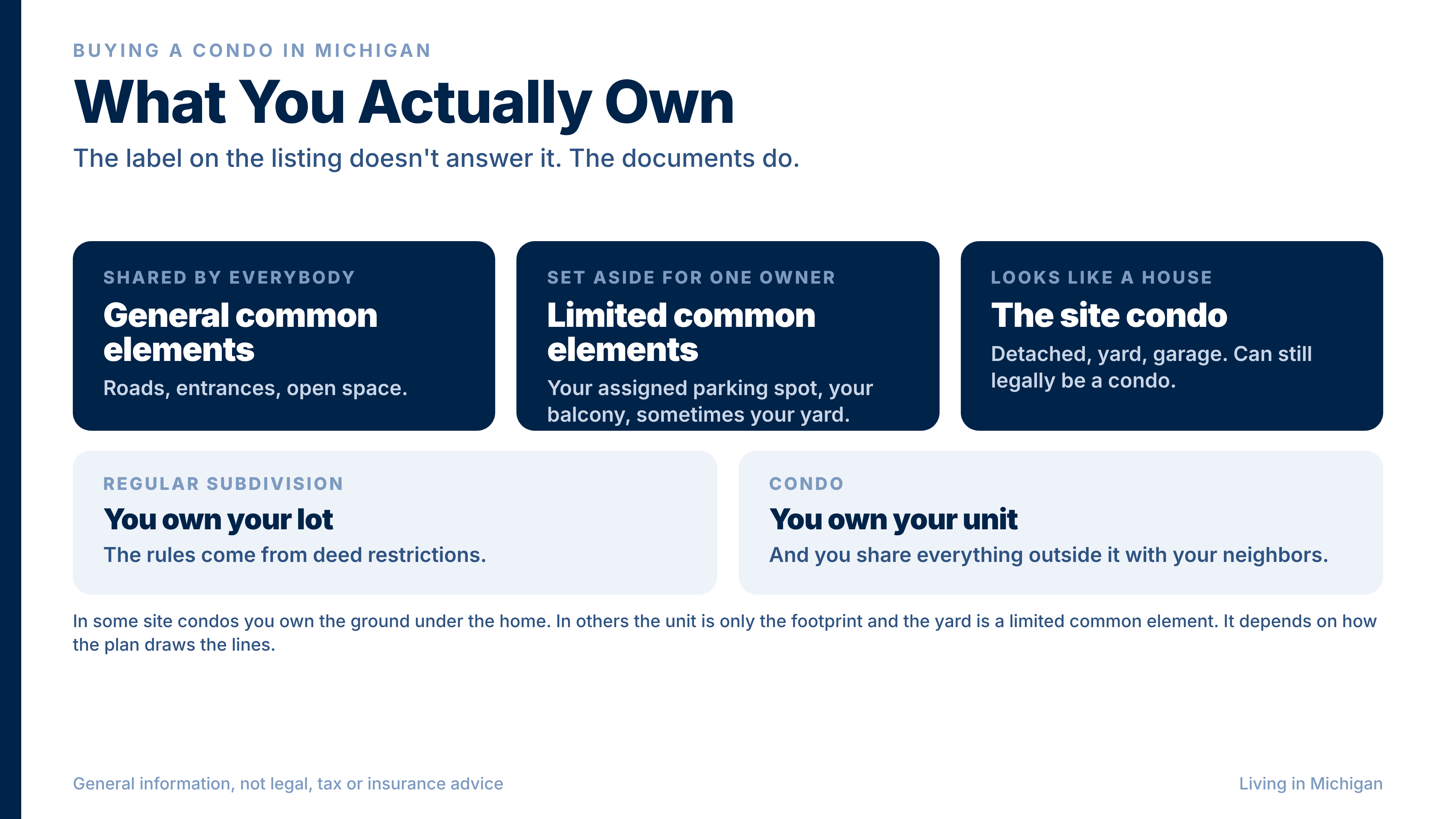
In a traditional subdivision, you generally own a parcel of land subject to any applicable deed restrictions or other recorded obligations.
In a condominium, you own a condominium unit together with an interest in the project's common elements. The unit's boundaries can vary significantly depending on the development.
In some detached site condos, the unit includes the land surrounding the house. In others, the unit may consist primarily of the building footprint, while the surrounding yard is designated as a limited common element.
That distinction can affect what you maintain, what you can change, and what the association controls.
Before buying, ask for the condominium subdivision plan and master deed. Those documents explain the legal boundaries and ownership arrangements far more reliably than a real estate listing description.
2. Not All Michigan Condo Associations Provide the Same Services
One of the biggest reasons people buy condos is convenience.
Maybe you're tired of cutting the grass every weekend. Maybe you're done shoveling snow before work. Or maybe you want a home where you can lock the door, head to Florida for a few months, and not worry about who is maintaining the property.
That sounds great, but here's the catch: buying a condo doesn't automatically mean you're getting any of those services.
I like to think about condominium associations in terms of two separate questions: how much maintenance does the association handle, and how much control does it exercise over the property?
Some site condominium associations primarily maintain shared infrastructure, including private roads, drainage systems, landscaping around entrances, or common recreational areas. Individual owners may still be responsible for mowing their own lawns, clearing snow, maintaining their roofs, and repairing their homes.
Other associations handle lawn maintenance and snow removal while leaving most building repairs to individual owners.
And in some attached condominium developments, the association maintains roofs, siding, exterior structures, grounds, and certain utilities.
The rules can vary just as much as the services.
One association might allow considerable flexibility with exterior decorations and landscaping. Another might require approval before you change your front door, install a fence, replace windows, or even put something on your porch.
Neither arrangement is automatically better. It depends on whether you value personal control, convenience, or some combination of the two.
Whenever you see the phrase "low-maintenance living" in a Michigan condo listing, ask exactly what that means for that specific property.
3. Your HOA Fee Could Be Paying for a Road You'll Eventually Have to Replace
Here's something I wish more buyers understood about Michigan site condos: private roads.
In many condominium developments, the streets are privately owned or maintained rather than being maintained by the local municipality.
That means the association may be responsible for snow removal, pothole repairs, drainage, resurfacing, and eventually replacing the asphalt.
And replacing a road isn't cheap.
Imagine moving into a development where the HOA fee is only $100 a month. Sounds pretty reasonable, right?
But if the association hasn't saved enough money for road replacement, that inexpensive monthly fee could eventually turn into a substantial special assessment.
A special assessment is an additional charge imposed on owners to cover expenses beyond the association's regular budget, subject to the governing documents and applicable law.
Before purchasing a site condo, find out who owns and maintains the roads, when they were last resurfaced, whether major work is planned, and how the association intends to pay for it.
The same principle applies to roofs, siding, elevators, parking structures, and other shared components in traditional condominium buildings.
A low monthly fee is only attractive if the association can afford to maintain the property properly.
4. Read These Condominium Documents Before You Commit
I know. Nobody gets excited about reading a 90-page master deed.
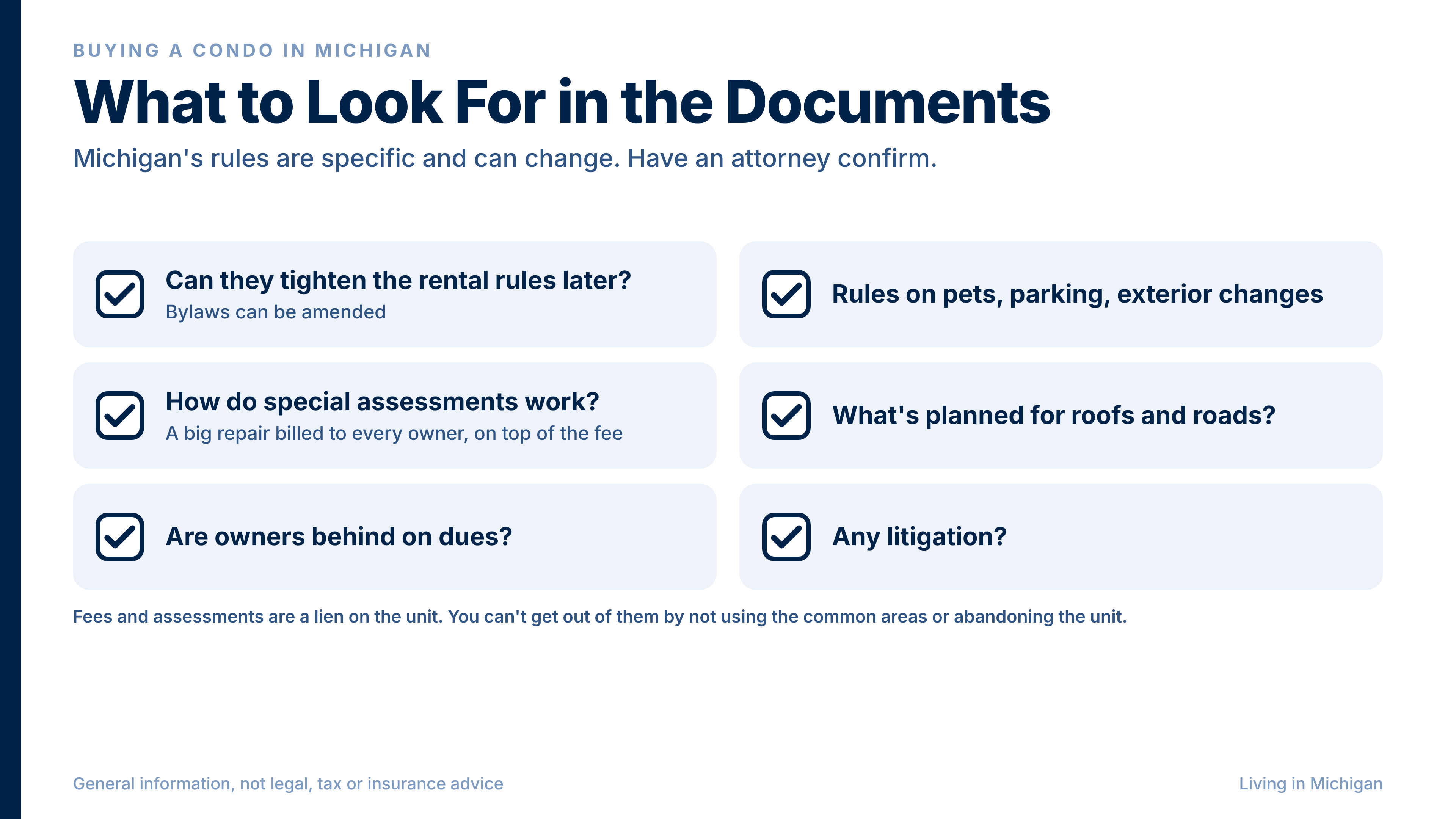
But those pages can determine whether you can rent your property, keep your pets, modify your home, park certain vehicles, or be charged thousands of dollars for repairs.
Michigan's Condominium Act requires condominium associations to keep current copies of the master deed, amendments, and other condominium documents available for review by prospective purchasers.
At a minimum, I recommend requesting the master deed, condominium subdivision plan, bylaws, current rules and regulations, association budget, recent financial statements, and information about pending or recently approved special assessments.
I would also ask for recent meeting minutes, available reserve studies, maintenance plans, and any disclosures concerning significant litigation or outstanding repairs.
Don't just skim the section about pets and call it a day. Review the financial obligations and maintenance responsibilities, too.
One particularly important question is whether the association can amend its rules in the future. Depending on the governing documents and applicable law, restrictions concerning rentals, occupancy, and other matters may change.
That means a property that permits a particular use today might not necessarily permit it forever.
When appropriate, ask your Realtor about negotiating a condominium document review contingency. This can provide an agreed period to review the documents and evaluate whether the community works for you.
And if you're unsure what a provision means, have a Michigan real estate attorney review it before you proceed.
For a free starting point, Michigan's Department of Licensing and Regulatory Affairs publishes a Condominium Buyer's Handbook.
5. A Healthy Condo Association Needs More Than Money in the Checking Account
When buying a condominium, you're evaluating more than the individual property. You're also evaluating the financial health of the association responsible for maintaining the development.
Think about it this way: if you buy a regular detached house and the roof needs replacing, that's your expense. You can plan for it, save for it, and decide when to schedule the work.
In a condominium where the association maintains the roof, that expense may be shared among owners through regular assessments, reserve funds, or additional charges.
Michigan's condominium administrative rules establish a minimum reserve fund requirement equal to 10% of the association's current annual budget on a noncumulative basis.
But here's the important distinction: meeting the legal minimum does not automatically mean an association has enough money for its future repairs.
A development with aging roofs, deteriorating roads, or expensive shared mechanical systems may need substantially more.
When reviewing an association, I want to understand how much money is in reserves, what major expenses are expected, whether owners are behind on their payments, and whether the board has a realistic plan for future maintenance.
For example, if the association knows that roofs will need replacing within five years, there should be a reasonable strategy for paying for them.
It's also worth reviewing how association fees have changed over time. Gradual increases aren't necessarily a bad thing. Sometimes they're evidence that the association is budgeting realistically for rising insurance, labor, and maintenance costs.
On the other hand, fees that remain unusually low for years while maintenance is deferred can create financial problems later.
My biggest red flags are major repairs without a funding plan, repeated unexpected assessments, significant unpaid dues, unresolved litigation, and difficulty obtaining basic financial information.
A well-maintained development with transparent finances may be worth paying a little more for each month.
6. The Real Cost of Buying a Condo Is More Than the Mortgage Payment
Let's talk about what buying a Michigan condo actually costs.
Your monthly housing budget needs to account for mortgage principal and interest, property taxes, insurance, association fees, utilities, and any maintenance expenses that remain your responsibility.
And depending on the development, you may also encounter transfer fees, account setup charges, move-in fees, or special assessments.
I recently helped a client purchase a condominium for approximately $330,000. The association fee was $318 per month and covered snow removal, structural maintenance, grounds maintenance, water, sewer, and trash service.
For someone who wants fewer maintenance responsibilities, those services can provide real value.
That transaction also included a $235 association transfer fee and management company account setup requirements.
Every association handles those details differently, so it's worth asking about them before closing.
In my experience with Southeast Michigan properties, association fees can range from relatively modest charges for site condos to several hundred dollars monthly for more comprehensive maintenance arrangements.
In my separate research into 55+ communities in Southeast Michigan, individual listing examples showed fees ranging from approximately $180 to $830 per month.
But comparing fees without comparing services can be misleading.
A $600 monthly fee that includes heat, water, exterior maintenance, and snow removal may represent a very different financial arrangement from a $250 fee that covers little more than landscaping.
To compare two properties fairly, calculate what you would pay for the services separately and identify which expenses remain your responsibility.
Also ask when the first association payment is due, whether any fees are collected at closing, and whether there are current or pending assessments.
7. Michigan Condo Property Taxes Can Increase After You Buy

If you're moving to Michigan from another state, this is one of the most important parts of the entire article.
Do not assume the property taxes shown on a condominium listing are what you'll pay after purchasing.
Michigan uses a taxable value system. While an owner holds a property, annual increases in taxable value are generally limited by the state's inflation-based formula, subject to a 5% cap and certain adjustments.
After most qualifying transfers of ownership, the property's taxable value uncaps in the following calendar year.
That means someone who purchased a condo 20 years ago could have a substantially lower taxable value than a new buyer of the same property.
Here's where people get confused. Michigan generally assesses property at 50% of its true cash value, but that doesn't mean the taxable value after purchasing will automatically equal half your purchase price.
The assessor determines the property's assessed value under Michigan law. A sale price can be relevant, but it isn't a guaranteed substitute for the assessor's valuation.
For illustration, let's assume a $330,000 condo has a taxable value of $165,000 after uncapping.
At 30 mills, the simplified annual property tax calculation would be approximately $4,950. At 48 mills, it would be approximately $7,920.
That's almost a $3,000 difference annually, even though the assumed taxable value is identical.
Actual millage rates depend on the property's municipality, county, school district, exemptions, and applicable taxing authorities.
And that brings us to another important Michigan-specific consideration: the Principal Residence Exemption.
Michigan's Principal Residence Exemption, commonly called the PRE, exempts a qualifying primary residence from up to 18 mills of local school operating taxes.
If the condo is your primary residence and you meet the eligibility requirements, that exemption can reduce your property tax bill. If it's a second home or investment property, you generally won't qualify for the same exemption.
On a taxable value of $165,000, an 18-mill difference would equal approximately $2,970 annually.
That's why two people purchasing similar properties can have very different property tax obligations.
Before buying, contact the local assessor to discuss the property's assessed value, taxable value, likely uncapping consequences, and available exemptions. Confirm whether you need to file a Principal Residence Exemption affidavit and any other transfer-related paperwork.
You can learn more through the Michigan Treasury's transfer of ownership guidance and Principal Residence Exemption information.
8. Condo Insurance in Michigan Depends on What the Association Covers
Here's a question I hear all the time: "The condo association already has insurance, so why would I need my own?"
Because the association's insurance policy and your individual insurance policy may protect different things.
In a traditional attached condominium, the association typically maintains a master insurance policy covering certain shared structures, common elements, and other property defined by the policy and governing documents.
Individual owners often purchase condominium unit-owner insurance, commonly called an HO-6 policy, for their personal belongings, liability, and the portions of the unit they're responsible for insuring.
But the details are not identical across every condominium development.
Some master policies cover more interior components than others. Depending on the policy and documents, cabinets, flooring, fixtures, improvements, or other items may fall under different coverage responsibilities.
Detached site condominiums can be especially different. In some developments, individual owners are responsible for insuring the entire house, while the association primarily insures shared infrastructure and common areas.
That's why you should never assume an HO-6 policy is automatically the right coverage for every property legally classified as a condominium.
Before closing, provide your insurance agent with the master deed, applicable bylaws, and information about the association's master policy.
Ask who insures the roof, exterior walls, windows, interior improvements, and any attached or detached structures. Also ask about deductibles, loss assessment coverage, water damage, sewer backup, and flood insurance.
Michigan winters make this especially important. A frozen or burst pipe can cause substantial damage, and the financial responsibility may depend on the source of the damage, the governing documents, and the insurance policies involved.
The time to figure that out is before a pipe bursts, not while you're standing in a flooded kitchen.
9. Your Condo Association Can Affect Whether a Buyer Gets a Mortgage
Here's something that surprises a lot of people: your mortgage approval isn't always based solely on your credit score, income, and down payment.
For certain condominium loans, lenders also evaluate the condominium project itself.
Depending on the financing program and required review, lenders may consider the association's financial condition, insurance coverage, deferred maintenance, litigation, occupancy characteristics, and other project requirements.
Fannie Mae, for example, has condominium project eligibility standards that lenders must consider when originating certain conventional loans.
Projects with critical repairs, inadequate insurance, or significant unresolved litigation can encounter financing problems.
And if a buyer can't obtain financing because of project-level issues, that can affect both the current purchase and your ability to sell later.
That's one reason I recommend speaking with your lender before you get too far into the process.
Tell the lender whether you're considering an attached condo or detached site condo. Ask whether the project will require additional documentation and whether the lender has experience financing similar properties in Michigan.
I've encountered transactions where lenders unfamiliar with Michigan site condominiums created unnecessary complications. That doesn't mean every out-of-state or online lender is a bad option. It simply means experience with the property type can be valuable.
Also ask about FHA, VA, and conventional financing eligibility if those loan programs may be relevant to your purchase or future resale plans.
For more information, review Fannie Mae's condominium project eligibility resources.
10. Think About Resale Before You Buy the Condo

Most buyers spend plenty of time thinking about whether they can afford a property today.
Fewer stop to ask whether they'll be able to sell it easily five or ten years from now.
Condominium resale value depends on many of the same factors as traditional real estate: location, condition, layout, comparable sales, and market demand.
But condos have additional considerations, including association fees, financing eligibility, rental restrictions, maintenance obligations, and the overall condition of the development.
If you're considering an older condo with an original kitchen, dated bathrooms, and an unfinished basement, compare it with renovated units in the same development.
That price difference can help you understand how the market values improvements, although it doesn't guarantee that every renovation dollar will be recovered at resale.
Look at how long similar units have taken to sell and whether the association has a history of significant special assessments.
Review rental restrictions, too. They can affect whether you could keep the condo as a rental property in the future. Depending on the project and financing program, investor ownership and other occupancy characteristics may also be relevant to lending requirements.
And don't forget practical details. If you're buying in a multistory building, consider the stairs or elevator, parking, storage, noise, and accessibility.
If you're purchasing a ranch-style condo, think about the entry steps, garage access, bathroom layout, and whether the property would remain convenient if your mobility needs change.
My general rule is to evaluate a condo as though you might need to sell it sooner than planned. If you understand the likely buyer pool, financing options, association rules, and condition of the property, you'll be in a much better position to make an informed decision.
A Real-World Condo Buying Checklist for Michigan
Before touring a condo, talk with your lender about the type of property you're considering and estimate the likely property taxes after purchasing.
Once you've found a property, review recent comparable sales, identify the association fee, and ask exactly which services are included.
When preparing an offer, discuss appropriate inspection and condominium document review contingencies with your agent. Request the master deed, bylaws, financial statements, association rules, and information about special assessments.
During your due diligence period, have the unit inspected, evaluate the association's maintenance responsibilities, and contact an insurance professional about the coverage required for that specific property.
Before closing, confirm any outstanding association balances, transfer charges, the timing of your first association payment, and the process for filing your Principal Residence Exemption if eligible.
And here's a tip that has nothing to do with paperwork: visit the development at different times of day.
See how parking works on a busy evening. Listen for noise if the unit has shared walls. Look at the condition of the roads, sidewalks, landscaping, and common areas.
If you have an opportunity to speak with residents, ask about their experience with maintenance and communication from the association.
Sometimes a five-minute conversation reveals things that aren't immediately obvious from a listing.
Is Buying a Condo in Michigan Worth It?
Absolutely, for the right buyer and the right property.
A condo can provide a practical alternative to traditional homeownership, especially if you want fewer exterior maintenance responsibilities, a single-level floor plan, or access to shared amenities.
But a condominium isn't automatically easier, cheaper, or less risky than owning a traditional house.
You're trading some control over the property for whatever services, amenities, and shared responsibilities the development provides.
The important thing is understanding that tradeoff before you commit.
I've helped buyers purchase condos that made perfect sense for their lifestyle and budget. The difference was that we understood the association, the property taxes, the insurance requirements, and the maintenance obligations before closing.
That's the approach I'd recommend whether you're buying your first condo, downsizing from a larger home, relocating to Michigan, or exploring a 55+ community.
Frequently Asked Questions About Buying a Condo in Michigan
What is a site condo in Michigan?
A site condominium is commonly used to describe a condominium development with detached homes or individually defined building sites. It is not a separate ownership category defined by the Michigan Condominium Act. The recorded master deed and subdivision plan establish the condominium units and common elements. A site condo can look almost identical to a traditional subdivision home.
Do you own the land when you buy a site condo in Michigan?
It depends on the legal boundaries of the condominium unit. In some developments, the unit includes the surrounding land. In others, the yard may be a limited common element rather than part of the individually owned unit. Review the recorded condominium subdivision plan and master deed to determine the actual ownership arrangement.
Are HOA fees mandatory for condos in Michigan?
Generally, condominium owners are obligated to pay the assessments established under their governing documents. Michigan's Condominium Buyer's Handbook explains that owners cannot avoid required assessments simply by not using common areas or abandoning their units.
Can a Michigan condo association increase HOA fees?
Associations may adjust assessments according to their governing documents and applicable law. The amount, approval process, and notice requirements can vary. Buyers should review historical fee increases, current budgets, and provisions concerning regular and special assessments.
What is a special assessment on a Michigan condo?
A special assessment is an additional charge that an association may impose on owners for expenses beyond regular assessments, subject to its governing documents and applicable law. Examples may include major roof replacements, road repairs, or other significant common-element expenses. Buyers should ask whether any special assessments are pending or anticipated.
How much money must a Michigan condo association keep in reserves?
Michigan Administrative Rule R 559.511 establishes a minimum reserve fund equal to 10% of the association's current annual budget on a noncumulative basis. This minimum does not guarantee that the reserve fund is adequate for a particular development's future repair needs. Source: Michigan Condominium Buyer's Handbook.
Can I request condo association documents before buying in Michigan?
Yes. Michigan Compiled Laws 559.168 requires associations to keep current copies of the master deed, amendments, and other condominium documents available at reasonable hours to prospective purchasers and certain other parties. Source: Michigan Condominium Act, Section 68.
Why do property taxes increase after buying a condo in Michigan?
Following most qualifying transfers of ownership, Michigan's taxable value uncaps in the calendar year after the transfer. A previous owner's taxable value may have been limited by years of capped increases, so a new owner's taxable value can be higher. Certain transfers are exempt from uncapping. Source: Michigan Department of Treasury.
Are condo property taxes calculated differently from house property taxes in Michigan?
Condominiums generally follow Michigan's property assessment and taxation framework, although individual property characteristics and exemptions affect the calculation. The applicable taxable value, local millage rates, and exemptions determine the tax bill. A condo isn't automatically taxed at a lower rate simply because it's a condominium.
What is Michigan's Principal Residence Exemption for condos?
Qualifying owners who use their condominium as their principal residence may receive an exemption from up to 18 mills of local school operating taxes. Eligibility and filing requirements apply. Source: Michigan Department of Treasury.
Does condo insurance cover the roof in Michigan?
It depends on the condominium documents and insurance policies. In some developments, the association's master policy covers the roof. In others, particularly certain detached site condos, individual owners may be responsible for insuring their entire homes. Ask an insurance professional to review the master policy and governing documents before purchasing.
What is HO-6 insurance for a Michigan condo?
HO-6 is a common type of condominium unit-owner insurance policy. Depending on the policy, it may cover personal belongings, liability, interior improvements, and other losses for which the owner is responsible. Coverage needs depend on the association's master policy, unit boundaries, and governing documents.
Can a condo association in Michigan prohibit pets?
Condominium documents may contain pet restrictions, subject to applicable law, including requirements relating to assistance animals. Review the current rules and obtain clarification before purchasing if keeping an animal is important to you.
Can I rent out my Michigan condo?
Rental rights depend on the condominium's governing documents and applicable law. Some developments permit rentals, while others impose restrictions or limitations. Michigan's Condominium Act provides procedures for amending condominium documents, including certain rental and occupancy provisions. Buyers should review existing restrictions and understand the possibility of future amendments.
Can you get an FHA or VA loan on a condo in Michigan?
Potentially, but eligibility depends on the applicable loan program, property, project requirements, and lender review. FHA and VA have condominium-related rules, and some projects may not qualify for particular financing programs. Ask your lender to evaluate the specific property before assuming a loan program will work.
Can you get a conventional mortgage on a Michigan site condo?
Yes, many site condominiums can be financed with conventional mortgages, subject to lender underwriting and applicable project requirements. Detached condominium projects may be reviewed differently from attached condominium developments. Inform your lender of the property's legal classification early in the process.
Can a condo association's financial problems prevent me from getting a mortgage?
Yes, in some circumstances. Certain mortgage programs require lenders to evaluate condominium project eligibility. Significant deferred maintenance, inadequate insurance, serious litigation, and other project-level issues can affect financing. Source: Fannie Mae Condo Status Finder.
Are condos harder to sell than houses in Michigan?
Not necessarily. Resale depends on location, condition, pricing, market demand, financing availability, and the development's characteristics. Association fees, restrictions, financial health, and maintenance responsibilities may influence the number of interested buyers.
Is a condo or traditional house better for retirement in Michigan?
That depends on your lifestyle, finances, maintenance preferences, accessibility needs, and long-term plans. A condo may reduce certain maintenance responsibilities, but not all condominiums provide the same services. A traditional house may offer greater control over the property while requiring more individual upkeep.
Thinking About Buying a Condo in Southeast Michigan?
Whether you're exploring a detached site condo in Oakland County, a ranch condo in Macomb County, an attached condominium in Wayne County, or an age-restricted community elsewhere in Southeast Michigan, understanding the details before making an offer can save you a tremendous amount of frustration.
I'm Andrew McManamon, a Michigan Realtor and the creator of Living in Michigan. I help buyers and sellers throughout the region understand local real estate markets, property taxes, financing considerations, and the details that aren't always obvious in online listings.
If you're researching age-restricted housing, check out my free 55+ Communities in Southeast Michigan Guide, which includes community comparisons, historical pricing research, and questions to ask before purchasing.
And if you're relocating to Michigan, my free 74-page Michigan Relocation Guide can help you prepare for the move, understand the homebuying process, and compare communities throughout the state.
Buying a condo can be a great decision. Just make sure you're buying the lifestyle, financial arrangement, and ownership structure you actually want.
Disclaimer: This article provides general real estate education and is not legal, tax, lending, or insurance advice. Condominium documents, laws, lending requirements, and individual circumstances vary. Consult qualified professionals about your specific transaction.

Check Out the EXCLUSIVE "Living In Michigan" Apparel HERE



Living in Madison Heights Michigan: Homes, Taxes, Schools …
Madison Heights might be one of Metro…