
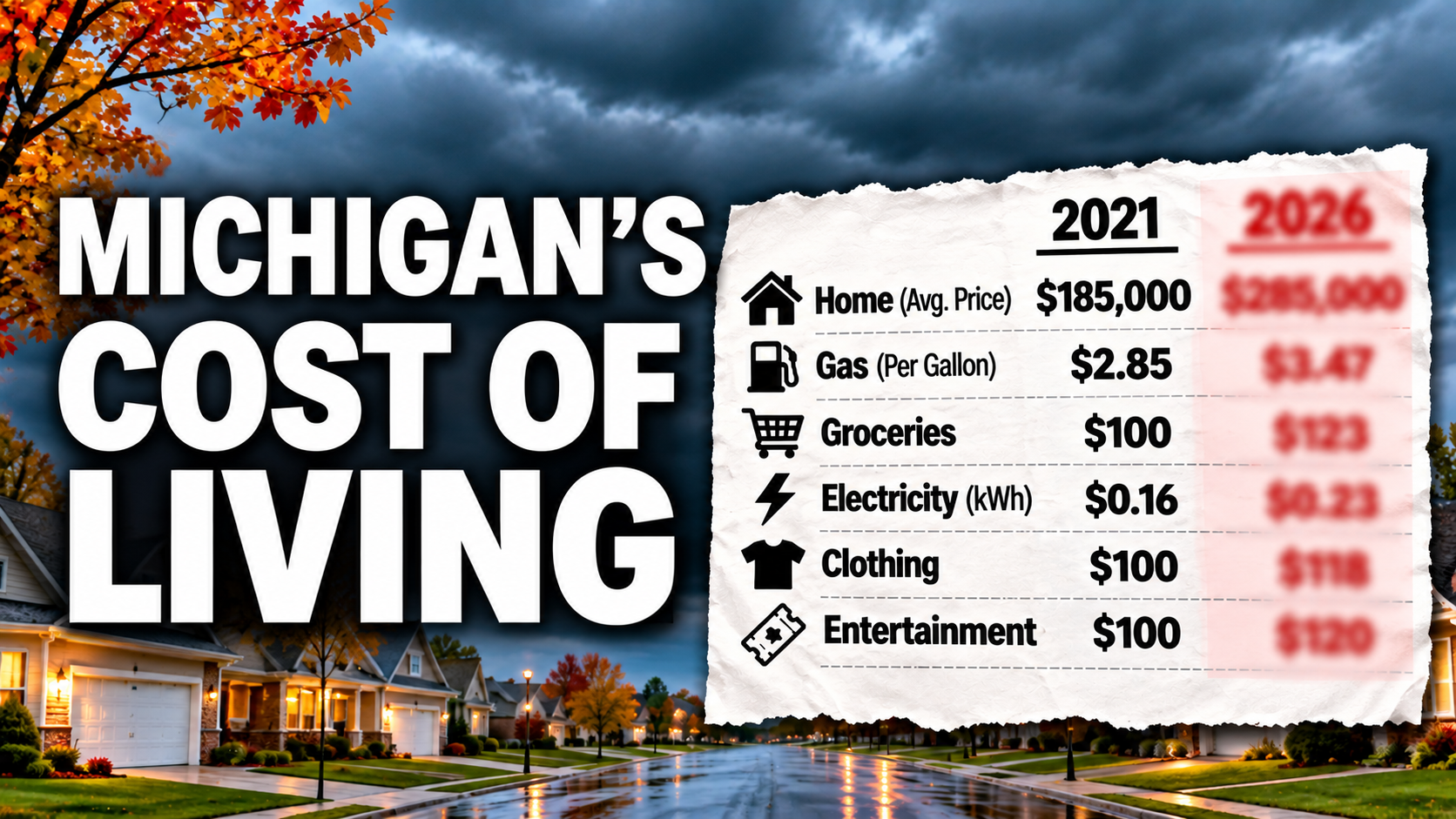
Five years ago, I made a video about the cost of living in Michigan. Back then, electricity was around 16 cents per kilowatt-hour, Michigan's gas tax was 26.3 cents per gallon, and you could find homes in parts of Metro Detroit for prices that would make today's buyers question whether the listing was missing a zero.
Fast-forward to 2026, and things look a little different.
Electricity has gotten significantly more expensive. Home prices have climbed. Groceries cost more. And apparently, getting a few things at the grocery store now requires a financial planning session.
But here's the interesting part. Even after five years of rising prices, Michigan remains relatively affordable compared with many parts of the country.
So what's actually changed? How much does it cost to live in Michigan today? And if you're thinking about relocating to Michigan, how much money should you realistically budget?
I'm Andrew McManamon, a Michigan Realtor and the creator of Living in Michigan. I help people relocate throughout the state, particularly Southeast Michigan, and I spend a lot of time explaining the expenses that don't always show up when someone searches for homes online.
I went back through the numbers from my original 2021 cost-of-living video and compared them with more recent data. Some of the differences surprised me.
Here's what you need to know before making Michigan your next home.
Michigan Cost of Living in 2026: The Numbers at a Glance
Before getting into housing, taxes, utilities, and everything else, let's look at the bigger picture.
According to BestPlaces' cost-of-living index, where 100 represents the national average, Michigan has an overall score of approximately 91.5.
That suggests Michigan's general cost of living is about 8.5% below the national benchmark on that particular index.
But remember, a cost-of-living index is a comparison tool. It doesn't mean every household will spend exactly 8.5% less than the national average, and it certainly doesn't mean every Michigan city is inexpensive.
| Cost category | 2021 benchmark | 2026 research |
|---|---|---|
| Overall cost-of-living index | 89.6 | 91.5 |
| Housing index | 65.5 | 71.2 |
| Utilities index | 100.1 | 100.1 |
| Residential electricity | 16.07¢/kWh | 22.99¢/kWh |
| Michigan gasoline excise tax | 26.3¢/gallon | 52.4¢/gallon* |
| Southeast Michigan median home sale price | Not directly comparable | $285,000 |
Sources: BestPlaces index figures and energy-price comparisons from the author's 2021-to-2026 research; Michigan Department of Treasury for gasoline taxes; Realcomp MLS research for Southeast Michigan home sales. Figures represent different geographic areas and reporting periods. *Michigan eliminated its separate sales tax on gasoline in 2026 as part of the fuel-tax restructuring.
There's one thing I want you to take away from this table: Michigan hasn't suddenly become an expensive state by national standards, but the discount isn't quite as dramatic as it used to be.
And where you choose to live makes a massive difference.
A home in Ann Arbor, Birmingham, or certain parts of Oakland County can cost considerably more than a comparable property in other Michigan communities. Meanwhile, there are still markets throughout Genesee County, parts of Macomb County, and other areas of the state where buyers can find substantially lower purchase prices.
That's why I always tell relocating buyers to compare specific communities instead of treating Michigan as one giant housing market.
How Much Has the Cost of Living in Michigan Increased Since 2021?
If it feels like your paycheck doesn't go as far as it did five years ago, you're not imagining things.
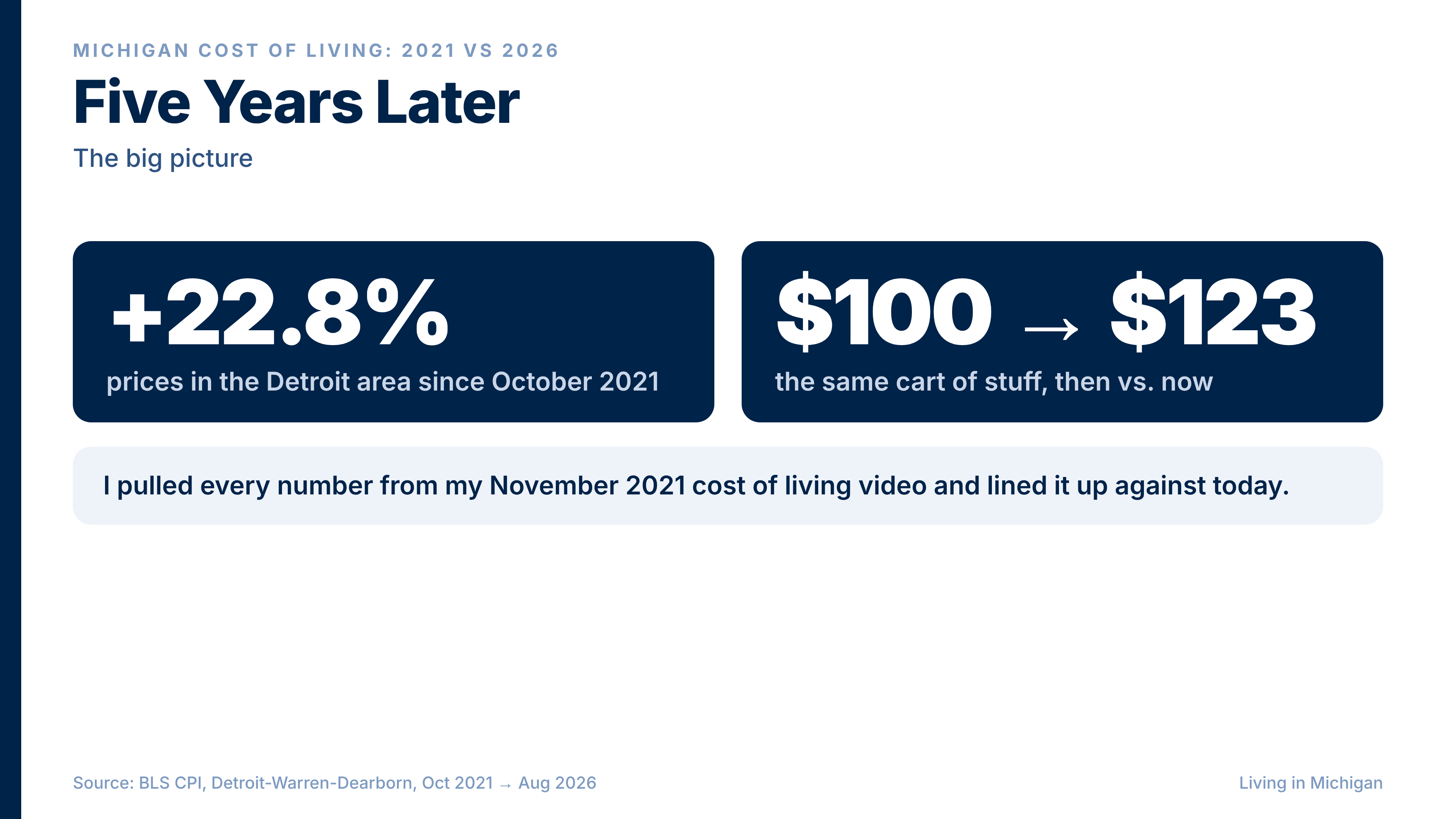
My five-year research puts cumulative Detroit-area inflation at approximately 23% over the period examined. The Bureau of Labor Statistics' Consumer Price Index tracks changes in prices for goods and services, including housing-related expenses, transportation, food, and energy.
To put a roughly 23% increase into perspective, a collection of goods and services costing $100 in 2021 would cost approximately $123 after that increase.
Now imagine applying that difference to groceries, home repairs, restaurant visits, utilities, and everything else you buy throughout the year.
It adds up quickly.
One important distinction is that inflation doesn't mean every expense increased at the same rate. Some categories increased substantially faster than others, while individual prices can move up or down from month to month.
Electricity is a particularly good example of an expense that outpaced general inflation.
For the latest Detroit-area inflation releases, visit the Bureau of Labor Statistics.
Are Michigan Salaries Keeping Up With the Cost of Living?
Housing prices don't mean much without considering what people actually earn.
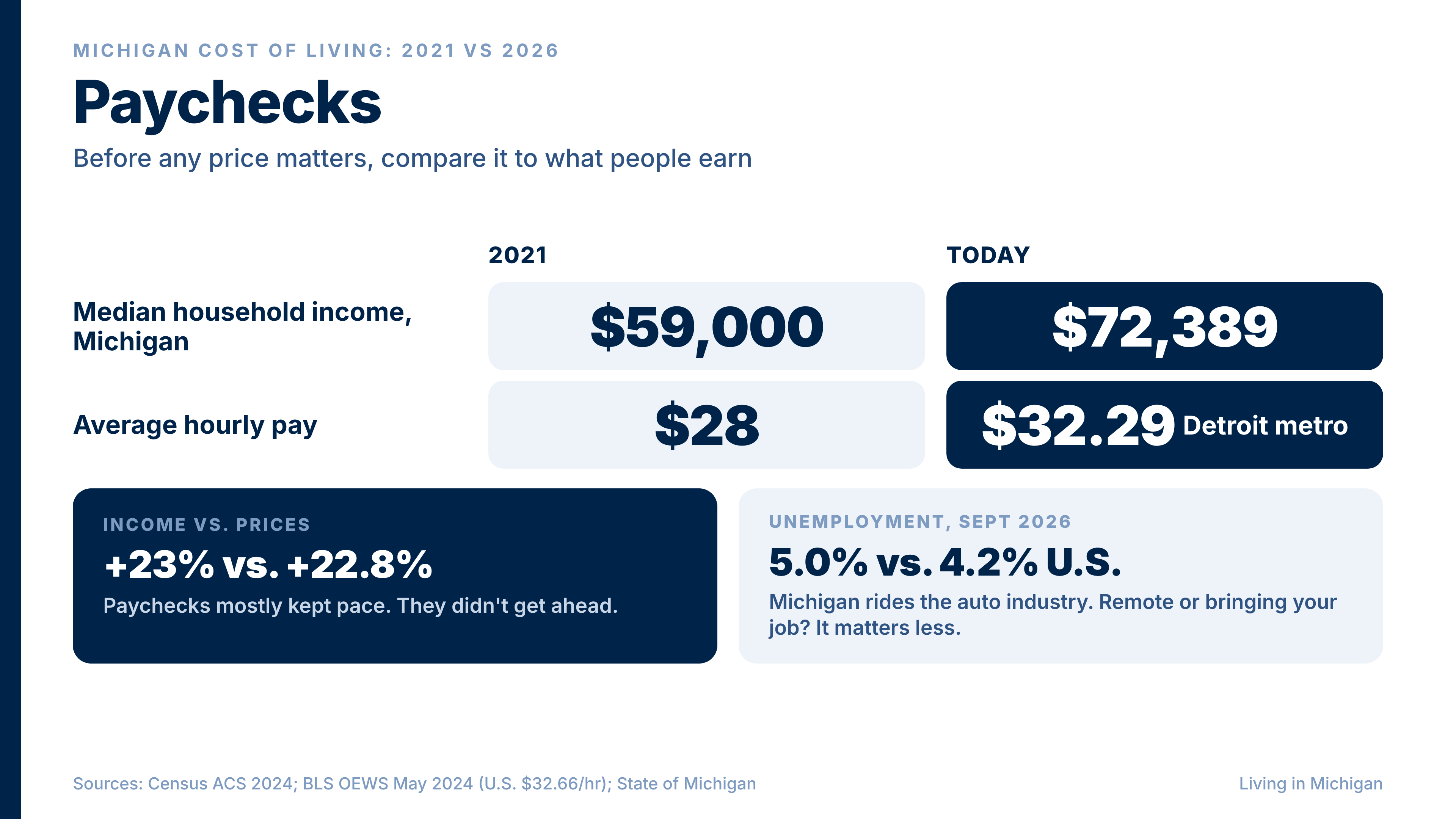
Back in 2021, the typical Michigan household income was approximately $59,000 in the data I used for my original video.
More recent Census estimates place Michigan's median household income in the low $70,000s. The Census Bureau's 2020–2024 American Community Survey estimates report approximately $72,875 in 2024 dollars.
That represents a meaningful increase from the earlier benchmark, although differences in survey periods and inflation adjustments mean it isn't a perfect apples-to-apples comparison.
The more important question is whether income growth has translated into greater purchasing power.
For some households, absolutely. People who changed jobs, received significant raises, or purchased homes before prices and mortgage rates climbed may be in a stronger position.
For others, higher wages have largely been absorbed by rising housing costs, insurance premiums, groceries, and utilities.
Recent federal wage research also places average hourly pay in Metro Detroit near the national average, but that doesn't mean every occupation pays similarly.
Michigan's economy has a substantial manufacturing and automotive presence, along with healthcare, education, technology, logistics, and professional services.
If you're relocating with a remote job and keeping your existing salary, Michigan's housing costs may be particularly attractive.
If you're moving here and need to find employment afterward, I would research salaries in your specific field before making the move.
My advice is simple: don't compare your current salary with Michigan's average income. Compare the salary you're realistically likely to earn with the cost of living in the actual city where you want to live.
Source: U.S. Census Bureau QuickFacts: Michigan.
Michigan Home Prices: The Biggest Expense for Most Relocating Buyers
Let's talk about housing, because this is where I spend most of my time helping people understand the market.
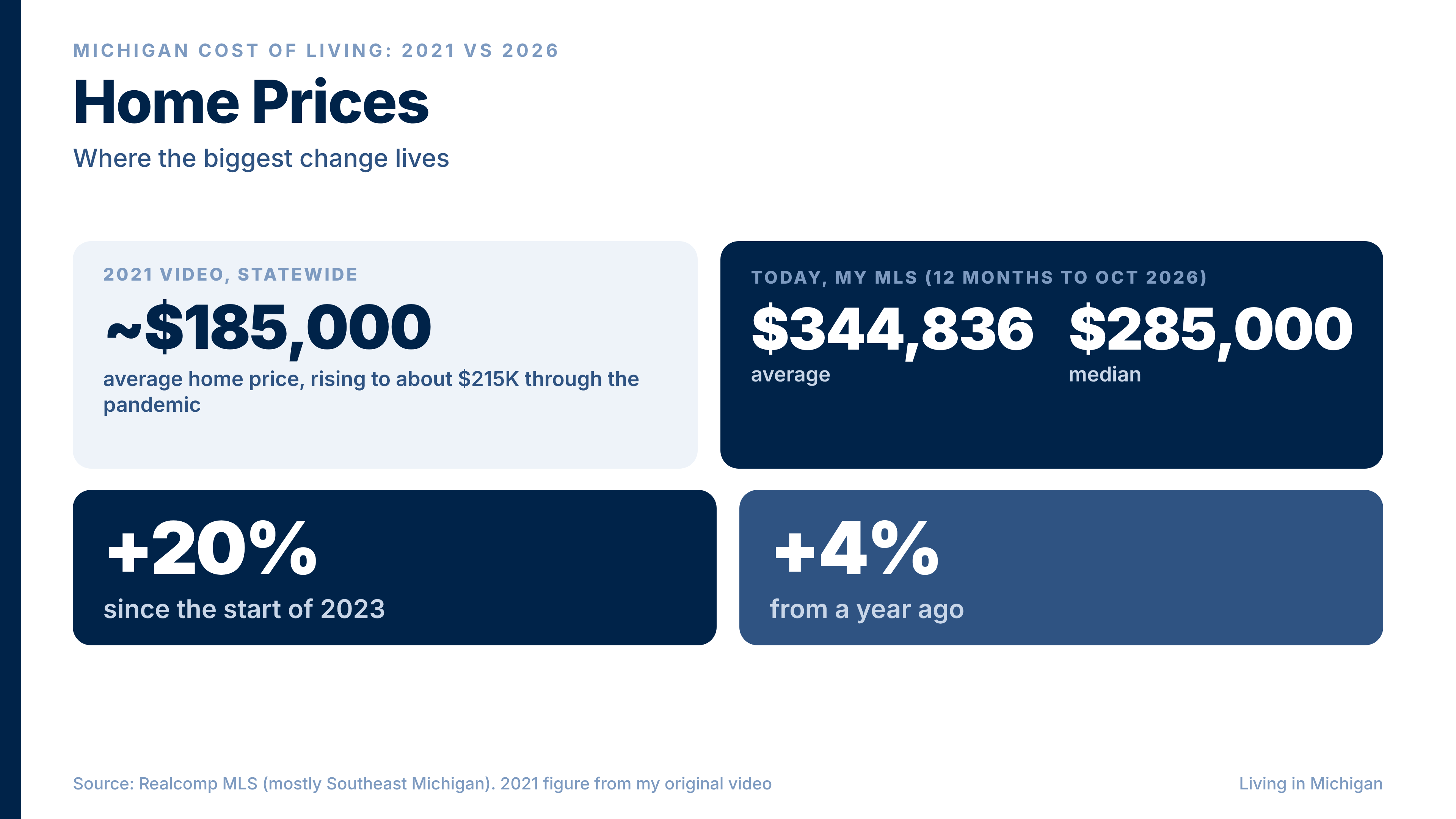
In my original 2021 video, I referenced Michigan home prices around $185,000, with prices climbing rapidly during the pandemic.
Today, the picture looks considerably different.
According to the Realcomp MLS research I pulled for Southeast Michigan, the average sale price over the preceding 12 months was approximately $344,836, while the median sale price was $285,000.
Those figures are important, but they are not statewide averages. Realcomp primarily covers Southeast Michigan and surrounding markets.
And there's a reason I like showing both the average and median.
The average can be pulled upward by expensive home sales. The median represents the middle sale price in the dataset, making it a useful way to understand the typical transaction.
For many buyers, that $285,000 median is a much more practical starting point than the average.
But don't assume $285,000 buys the same home everywhere.
In some communities, that budget might get you a comfortable ranch with a yard and garage. In others, you may be looking at a smaller condominium, an older home needing updates, or a property farther from the downtown area you originally wanted.
And in certain higher-priced markets, $285,000 may not get you very far at all.
Why Are Michigan Home Prices Still So High?
There are several reasons housing has become more expensive, but two stand out: limited inventory and the mortgage-rate lock-in effect.
Many homeowners purchased or refinanced when mortgage rates were historically low. Selling a home with a mortgage rate around 3% and purchasing another property at a substantially higher rate can increase monthly housing costs, even if the new house isn't dramatically more expensive.
So what do some homeowners do?
They stay put.
And when fewer homeowners list their properties, buyers have fewer options.
Michigan has also experienced long-term challenges related to housing construction and supply in certain markets. New construction can help, but building costs, available land, infrastructure, labor, and local development requirements affect what gets built and at what price.
That doesn't mean home prices can only go up. Real estate is local, and markets can soften when demand, affordability, financing conditions, or employment changes.
But if you're waiting for every Michigan home to suddenly return to 2019 prices, I wouldn't build your entire relocation strategy around that possibility.
What Does a $285,000 Home Actually Cost Per Month in Michigan?
Let's make this practical.
Imagine you're buying a $285,000 home with 10% down. That leaves a mortgage of $256,500 before any financed fees.
For illustration, let's use a 30-year fixed mortgage at 6.5% interest. This is a hypothetical rate, not a current lender quote.
| Expense | Illustrative amount |
|---|---|
| Purchase price | $285,000 |
| Down payment (10%) | $28,500 |
| Loan amount | $256,500 |
| Principal and interest | Approximately $1,621/month |
| Property taxes | Depends on location and taxable value |
| Homeowners insurance | Depends on property and coverage |
| Mortgage insurance | May apply |
| HOA fees | If applicable |
Notice how the mortgage payment is only part of the equation.
Property taxes, homeowners insurance, mortgage insurance, utilities, and maintenance can add hundreds of dollars to your monthly budget.
And if you're purchasing a condominium, association fees may replace some maintenance expenses while introducing an additional recurring payment.
That's why I don't like telling people they can afford a home based solely on its asking price.
What matters is the total monthly cost and whether it fits comfortably into your financial plans.
Michigan Property Taxes: Why the Seller's Tax Bill Can Mislead You
If you've watched my YouTube channel before, you've probably heard me talk about Michigan property taxes.
Probably more than you wanted to.
But there's a reason I keep bringing them up. This is one of the easiest expenses for relocating buyers to underestimate.
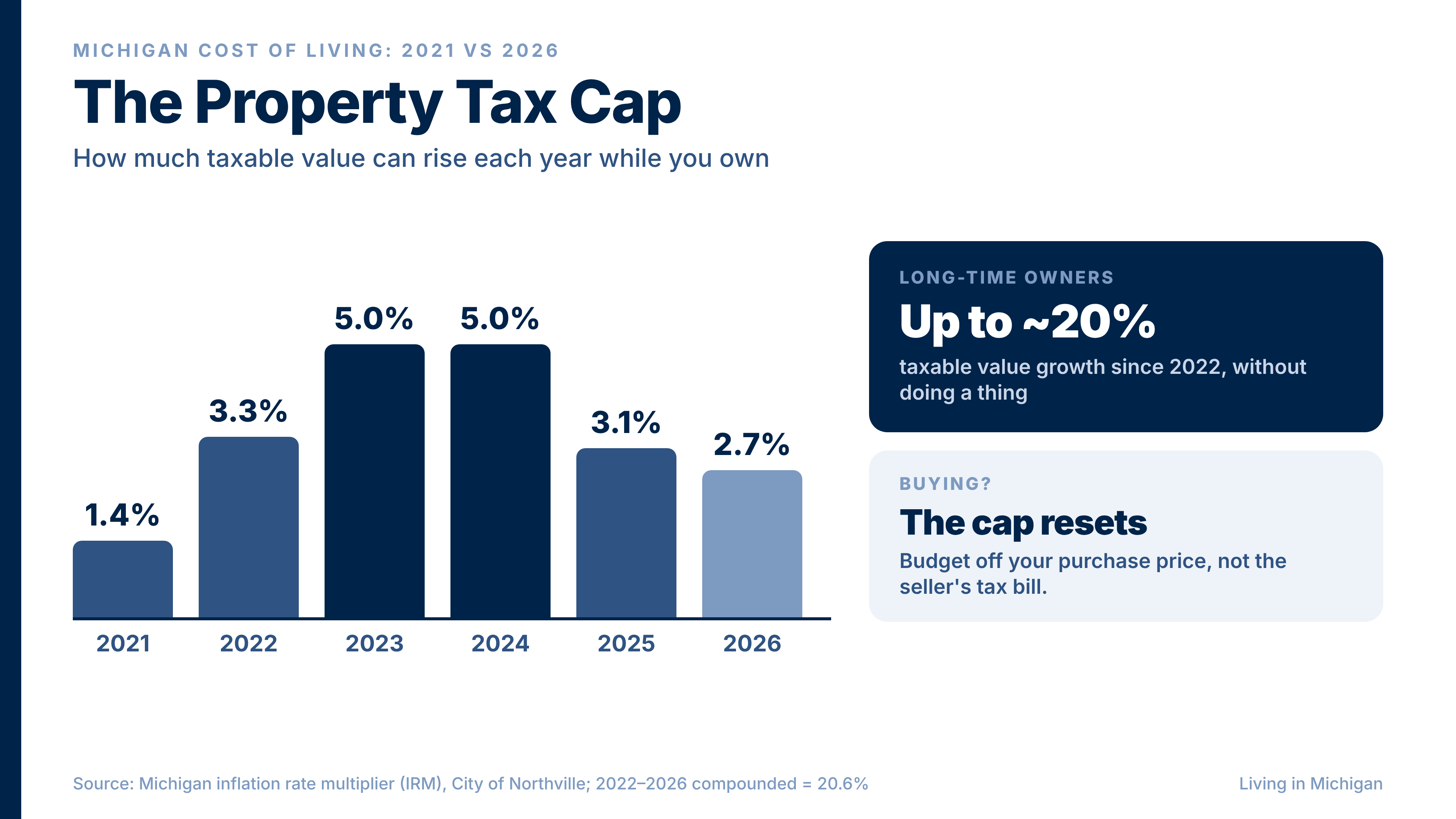
Michigan generally limits annual increases in a property's taxable value while the same owner holds it. The limit is based on inflation or 5%, whichever is lower, with adjustments for certain property changes.
For example, Michigan's taxable value inflation multiplier produced increases of 5% in both 2023 and 2024, followed by lower inflation adjustments in subsequent years.
Here's the catch: after most qualifying transfers of ownership, the taxable value uncaps in the following calendar year.
That means the seller might be paying taxes based on a taxable value that has been capped for years, while your taxable value after purchasing could be considerably higher.
And no, you shouldn't automatically assume your new taxable value will equal exactly half the purchase price.
Michigan generally assesses real property at 50% of true cash value, but the assessor determines that value under state law. Your purchase price is not a guaranteed assessment formula.
Local millage rates also vary depending on the municipality, county, school district, and applicable taxing authorities.
Here's a simple illustration. If a property has a taxable value of $150,000, a 30-mill effective tax rate produces approximately $4,500 in annual taxes, while a 45-mill rate produces approximately $6,750.
That's a $2,250 annual difference for the same taxable value.
If the property will be your principal residence, you may also qualify for Michigan's Principal Residence Exemption, which can exempt eligible owners from up to 18 mills of local school operating taxes.
Before buying, I recommend contacting the local assessor and requesting an estimate based on the property's likely post-transfer taxable value and your eligibility for exemptions.
Don't use the seller's current tax bill as your future budget.
Sources: Michigan Treasury: Transfer of Ownership and Principal Residence Exemption.
Electricity in Michigan Has Become Much More Expensive
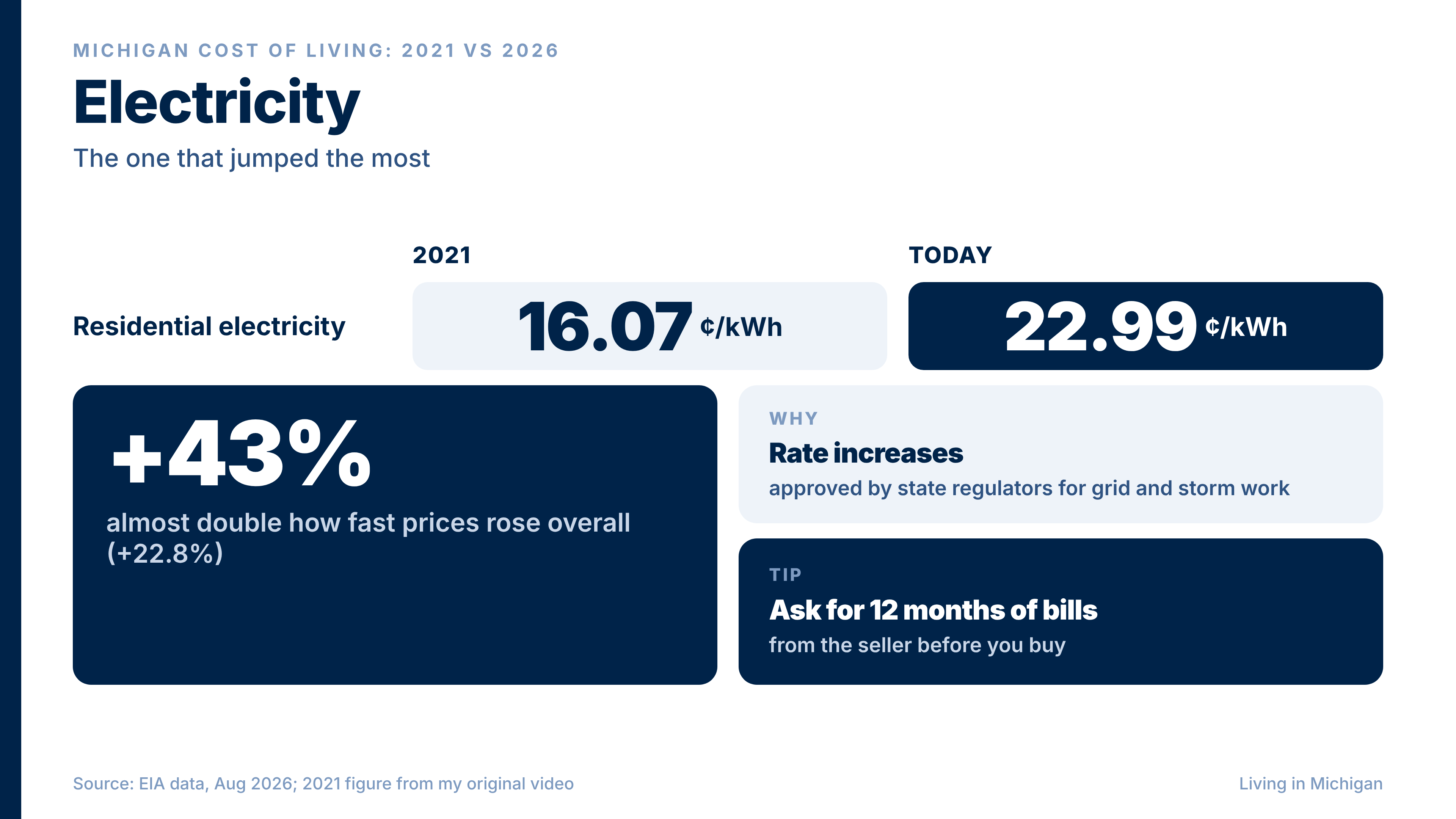
Of all the changes I reviewed, electricity was one of the biggest surprises.
In 2021, the average residential electricity rate in my original research was approximately 16.07 cents per kilowatt-hour.
The more recent federal energy figure used in my comparison was 22.99 cents per kilowatt-hour.
That's an increase of approximately 43%.
And unlike some expenses, electricity isn't exactly optional. Unless you've figured out how to run your refrigerator on positive thinking, you're going to need it.
Let's put that increase into perspective.
At 16.07 cents per kilowatt-hour, using 800 kilowatt-hours would cost approximately $129 in energy charges.
At 22.99 cents, the same usage would cost approximately $184.
That's about $55 more for the same electricity consumption, before accounting for the differences between actual utility bills and simple energy-rate calculations.
Electric rates and bills vary by utility, service territory, usage, season, and rate plan.
In Southeast Michigan, DTE Energy and Consumers Energy are two major electric utilities, but some areas have municipal or cooperative providers.
The Michigan Public Service Commission publishes utility rate information that can help you compare providers and understand how rates are structured.
Source: Michigan Public Service Commission.
What About Heating Bills During Michigan Winters?
Here's something I tell people relocating from warmer states: Michigan winters are manageable, but heating a house is a real budget item.
Natural gas is commonly used for residential heating throughout Michigan, although some properties rely on electricity, propane, fuel oil, or other systems.
Your heating costs depend on the home's size, insulation, age, windows, furnace efficiency, thermostat settings, and the weather.
A well-insulated 1,400-square-foot home can have very different heating expenses from an older 3,000-square-foot home with drafty windows.
And two homes with similar square footage may have surprisingly different utility bills.
If you're relocating, ask the seller for 12 months of actual utility usage and bills when available.
I would also pay attention to the age of the furnace, insulation levels, window condition, and whether the home has a basement, crawl space, or slab foundation.
One more thing: don't forget about snow removal.
If you're moving into a house with a long driveway, you'll either be buying a snowblower, hiring someone, or discovering muscles you haven't used since high school.
Michigan Gas Prices and the 2026 Gas Tax Change
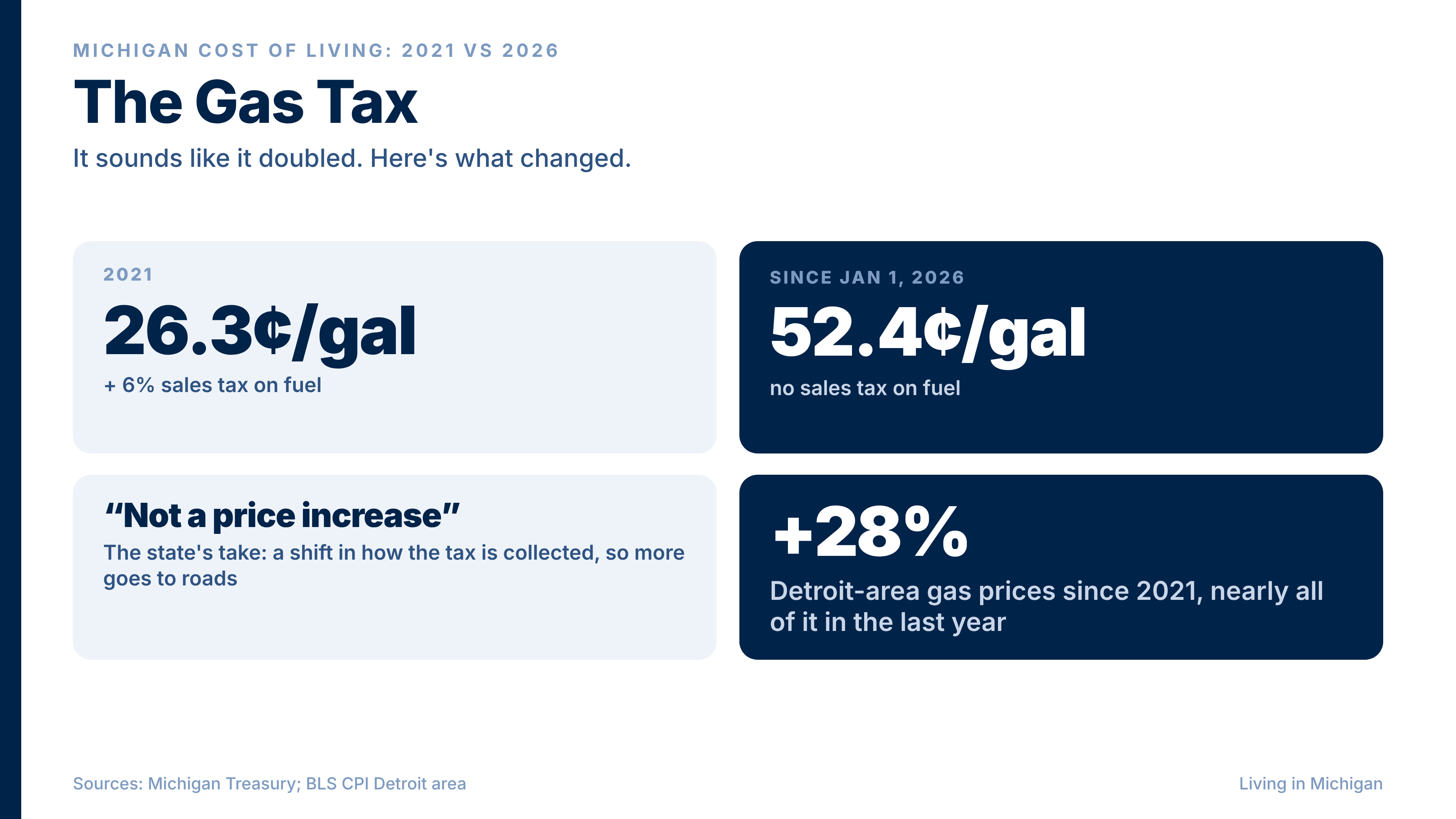
Let's talk about driving, because unless you live in one of Michigan's more walkable downtowns, you're probably going to spend a fair amount of time in your car.
Michigan changed how gasoline is taxed on January 1, 2026.
In 2021, the state's gasoline excise tax was 26.3 cents per gallon, and fuel was also subject to Michigan's 6% sales tax.
By 2025, the excise tax had risen to 31 cents per gallon.
Beginning in 2026, the excise tax increased to 52.4 cents per gallon, while the separate state sales tax on gasoline was eliminated.
Now, seeing a jump from 31 cents to 52.4 cents might make you think your gas taxes suddenly exploded.
But the state also removed the sales tax component, so the change was designed as a restructuring of fuel taxation rather than simply adding the entire excise tax increase on top of the previous tax structure.
The actual comparison depends on the fuel price and the applicable tax calculations. It also doesn't mean the retail price of gasoline will remain unchanged.
For example, gasoline prices are influenced by crude oil markets, refining, transportation, seasonal fuel requirements, and local competition.
And for Michigan households, transportation costs extend well beyond filling the tank.
Vehicle payments, insurance, maintenance, tires, registration, and commuting distance can become major expenses.
Source: Michigan Department of Treasury: Fuel Tax Changes.
Michigan Auto Insurance: The Expense People Forget to Compare
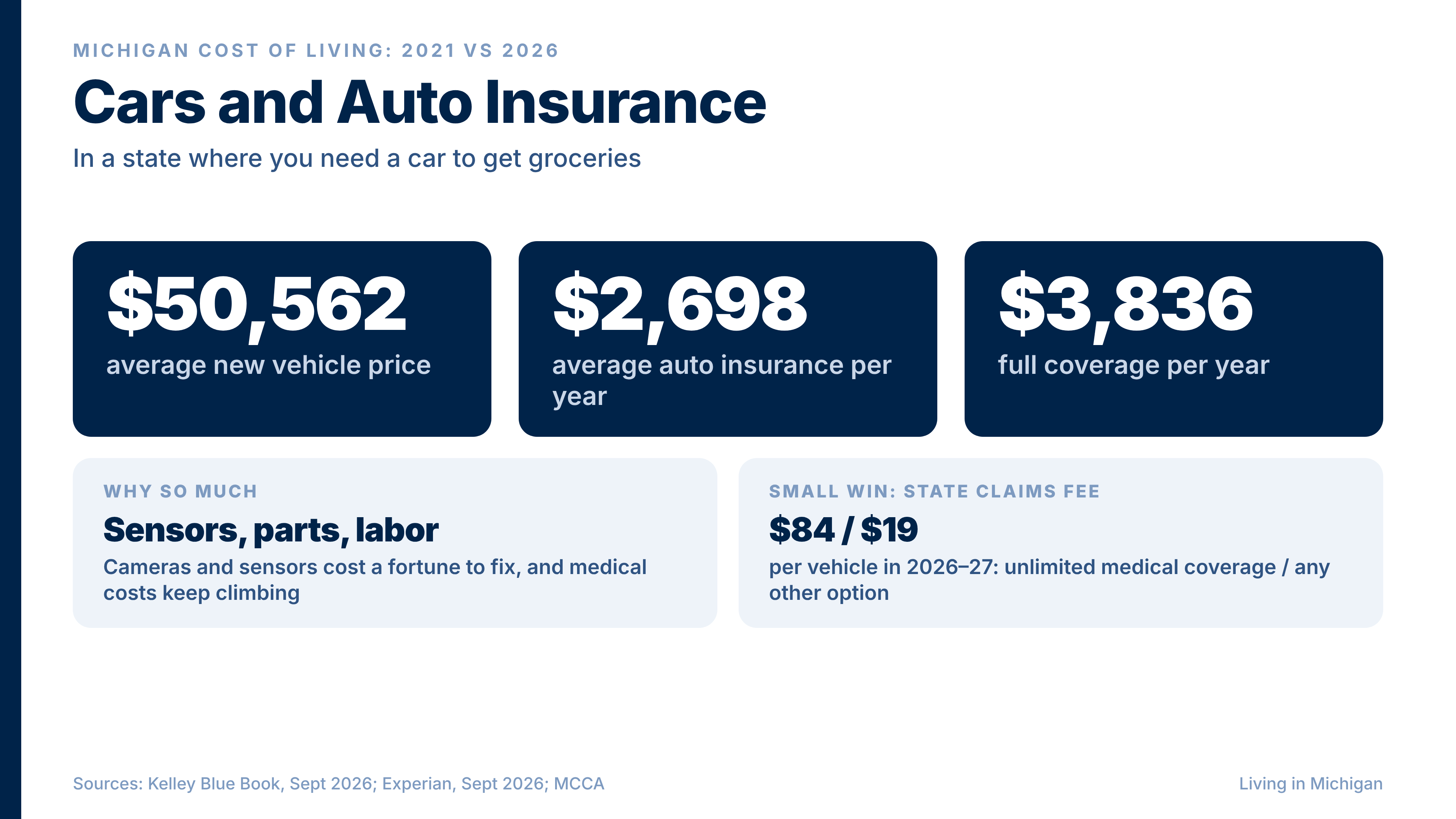
Michigan auto insurance has a reputation, and unfortunately, it isn't for being wonderfully inexpensive.
Recent Experian figures used in my research estimated average Michigan auto insurance costs around $2,698 annually, with full-coverage estimates around $3,836.
Those are estimates from a particular source and coverage methodology, not quotes every driver should expect to receive.
Your actual premium depends on your driving record, vehicle, location, chosen coverage, deductibles, and other rating factors permitted under Michigan law.
Michigan also has a no-fault auto insurance system, with personal injury protection coverage options and requirements that differ from some other states.
Insurance costs can be influenced by medical claims, vehicle repair costs, labor, parts, and increasingly sophisticated vehicle technology.
That little camera in your bumper? It's great until a parking lot accident turns into an expensive repair.
If you're moving from another state, get auto insurance quotes using your prospective Michigan address before relocating.
I'd compare multiple carriers and ask how the available personal injury protection options affect both premiums and coverage.
Source: Michigan Department of Insurance and Financial Services.
Homeowners Insurance in Michigan: Don't Wait Until Closing Week
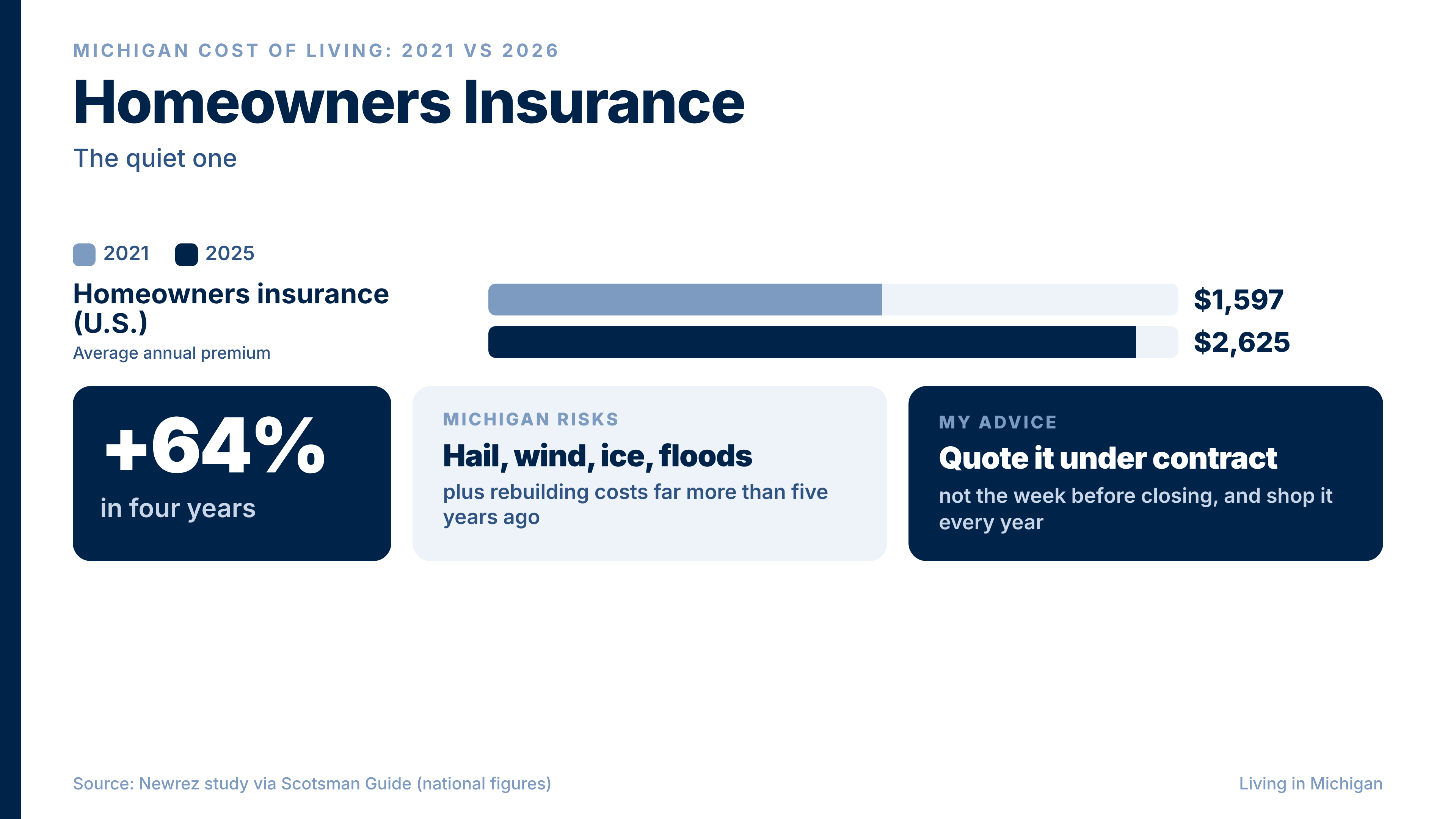
Homeowners insurance is another expense that has become harder to ignore.
National research referenced in my original script estimated that average annual homeowners insurance premiums increased from approximately $1,597 in 2021 to $2,625 in 2025.
That's a national comparison, not a Michigan-specific premium estimate.
Michigan has its own risks, including windstorms, hail, freezing temperatures, water damage, and occasional flooding.
Insurance companies also consider the cost of rebuilding a home, which can change as labor and material prices increase.
Two similarly priced homes may have different insurance premiums depending on roof age, construction, claims history, location, and coverage.
My advice is to request homeowners insurance quotes early in the purchase process.
And if you're purchasing a condominium, make sure you understand what the association's master insurance policy covers versus what you're responsible for insuring individually.
Flood insurance is another consideration. Standard homeowners policies generally do not cover flood damage, so evaluate the property's flood risk separately.
Source: National Flood Insurance Program.
How Much Do Groceries and Restaurants Cost in Michigan?
Now for the expense everybody notices every single week: food.
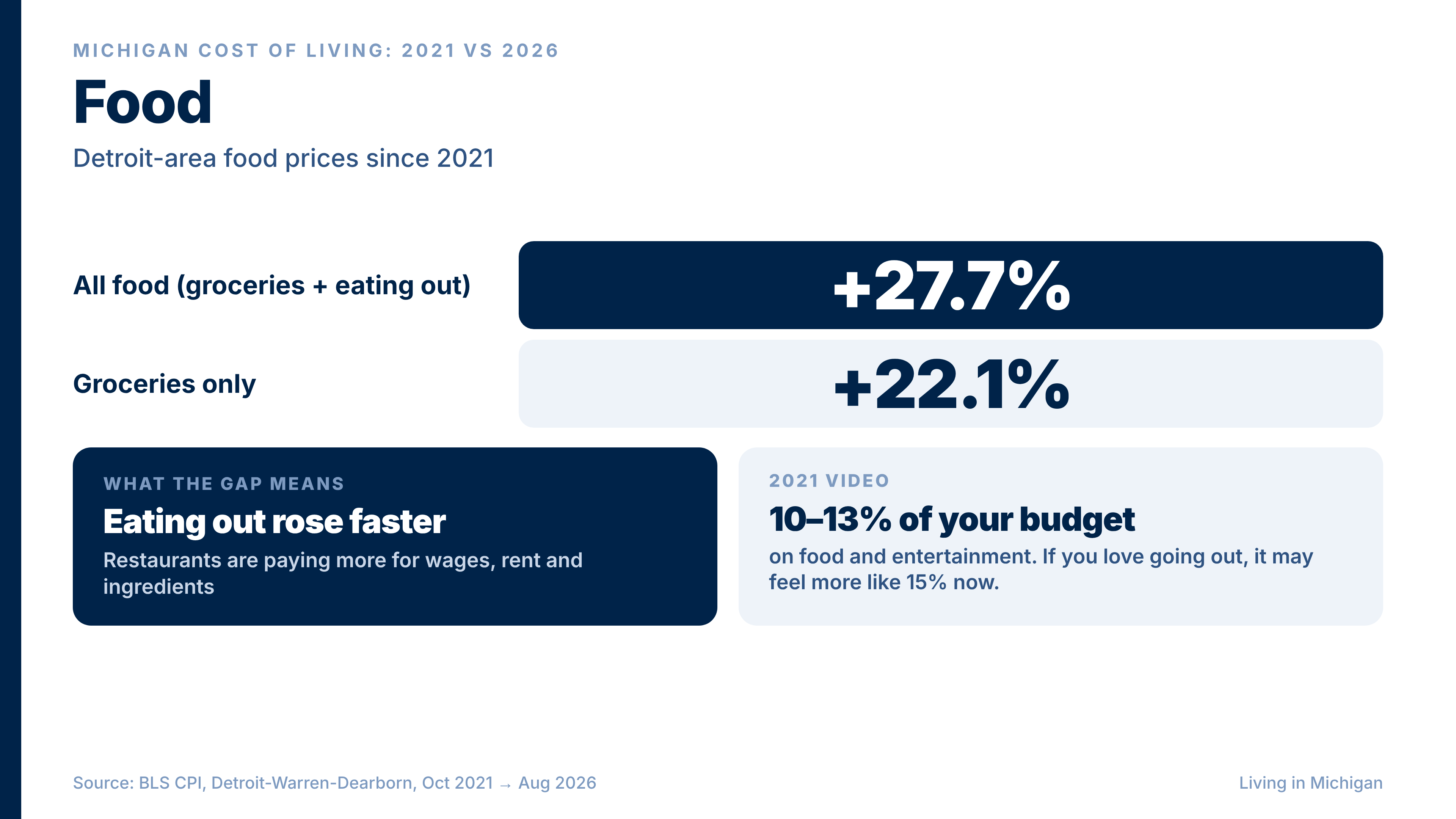
According to the five-year Detroit-area inflation comparison in my research, overall food prices increased approximately 28%, while grocery prices increased around 22%.
Those figures are historical comparison estimates, not a claim that every food item increased by those percentages.
Restaurants have faced rising labor, ingredient, insurance, and operating expenses, and some of those increases have been passed along to customers.
So if you feel like grabbing dinner and a couple of drinks now costs what a nice weekend getaway used to cost, you're probably not alone.
But there's a distinction worth making.
Michigan has plenty of grocery options, from large supermarket chains to discount stores, warehouse clubs, local markets, and seasonal farmers markets.
Depending on where you live, stores such as Meijer, Kroger, Aldi, Costco, and independent grocers may be part of your regular shopping routine.
Your monthly food budget will depend heavily on household size, dietary preferences, how often you cook, and how frequently you eat out.
For a realistic estimate, I'd recommend tracking your current grocery and restaurant spending for a month, then comparing prices at stores near the Michigan community you're considering.
Don't rely on a generic national grocery budget if your household's actual habits are very different.
Is Renting Cheaper Than Buying a Home in Michigan?
This is one of the questions I get most often from people planning a relocation.
And the answer is that it depends on the market, how long you plan to stay, your available cash, and the cost of financing.
Renting can make sense if you're unfamiliar with Michigan and want time to explore different communities before purchasing.
It can also reduce your exposure to certain maintenance expenses and the upfront costs of buying a home.
Buying may make sense if you're planning to stay for several years, have stable finances, and find a property whose total ownership cost works for your budget.
But don't assume a mortgage payment of $1,600 automatically means owning is cheaper than renting for $1,900.
Homeownership also involves property taxes, insurance, maintenance, closing costs, and the financial risks associated with the property.
On the other hand, renting doesn't provide the same ownership interest or potential equity accumulation.
If you're moving to Michigan for the first time, I'd compare the full monthly and upfront costs of both options rather than making the decision based on one number.
Where Is the Cost of Living Lower in Michigan?
Michigan is a large state, and affordability varies considerably between communities.
In Metro Detroit, buyers often compare areas in Oakland, Macomb, Wayne, Livingston, and Genesee counties. Each has communities with different housing prices, tax structures, commuting patterns, and property types.
For example, someone searching in Birmingham or certain parts of Ann Arbor may encounter much higher home prices than someone exploring parts of Flint, Burton, or other more affordable housing markets.
But lower purchase prices don't automatically mean lower total living costs.
Property taxes can differ substantially between municipalities. Transportation expenses may increase if you have a long commute. Older homes may require more repairs, and utility bills can vary by property condition.
That's why I recommend comparing locations based on your actual priorities.
If you're working remotely, proximity to a major employment center might matter less. If you commute daily, saving $40,000 on a house might not feel like much of a bargain if you're spending considerably more time and money driving.
And if you want a walkable downtown, access to parks, a particular school district, or proximity to relatives, those factors may influence which communities you consider.
The most affordable place isn't necessarily the place with the lowest listing price. It's the place where the overall cost of living works for your household and your lifestyle.
What About Education and College Costs in Michigan?
For households considering education expenses, Michigan offers a wide range of public school districts, community colleges, universities, and private institutions.
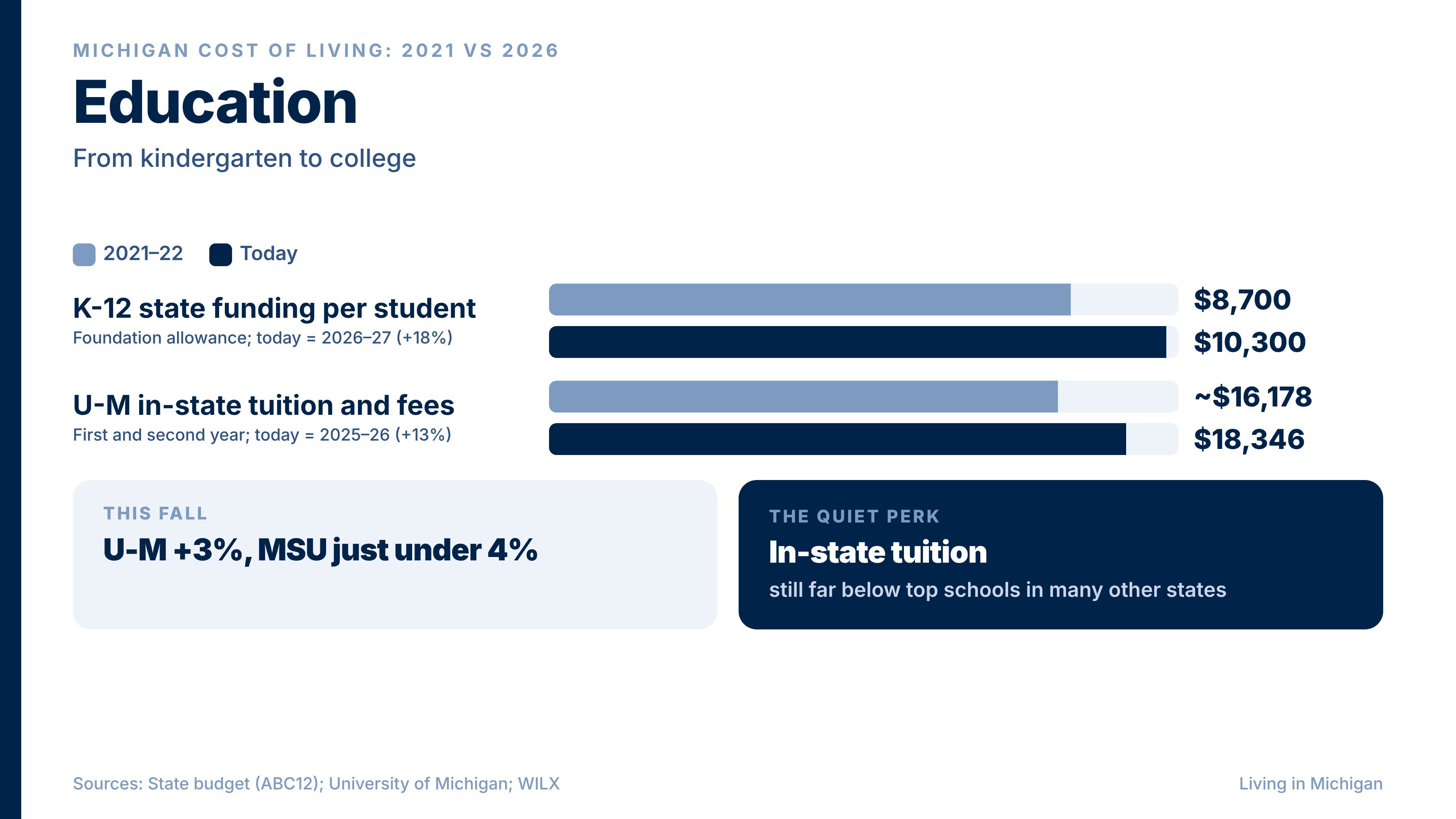
Michigan's K–12 school funding has increased since 2021, although district funding arrangements vary and state foundation allowances don't represent the entire operating budget of every school district.
For the 2026–27 school year, the state foundation allowance benchmark referenced in my research was approximately $10,300 per pupil.
If you're evaluating public schools, I'd review information for the specific district, including programs, enrollment policies, transportation, and publicly available performance data.
College expenses have also increased.
At the University of Michigan, the undergraduate in-state tuition and fee benchmark in my research rose from approximately $16,200 in 2021–22 to $18,346 in 2025–26 for the referenced student category.
Actual tuition varies by academic year, school or college, credit level, residency classification, and program.
Michigan State University, Wayne State University, Oakland University, Grand Valley State University, and other institutions have their own tuition schedules and financial aid opportunities.
When planning for college, remember to include housing, food, books, transportation, and fees, not just tuition.
Sources: Michigan Department of Education and University of Michigan Costs.
How Much Money Do You Actually Need to Live Comfortably in Michigan?
Here's where I think a lot of cost-of-living articles miss the point.
They'll give you one salary and tell you that's what you need to live comfortably in Michigan.
But comfortably for whom?
Someone living alone in a paid-off house has a completely different financial picture from a household buying a $450,000 home with two vehicle payments and childcare expenses.
And someone living in Ann Arbor may have a very different housing budget from someone living in a smaller community in Mid-Michigan.
Rather than giving you one magic number, I'd build your budget around your actual expenses.
Start with housing, including your mortgage or rent, property taxes, insurance, and association fees. Then add utilities, transportation, groceries, healthcare, debt payments, savings, and the activities you want to enjoy.
Here's an illustrative monthly budget for a hypothetical Michigan household purchasing a home. These are planning assumptions, not official statewide averages.
| Monthly expense | Example budget |
|---|---|
| Mortgage principal and interest | $1,621 |
| Property taxes | $450 |
| Homeowners insurance | $175 |
| Utilities and internet | $350 |
| Groceries | $650 |
| Transportation and auto insurance | $750 |
| Home maintenance savings | $250 |
| Restaurants and entertainment | $300 |
| Total | $4,546/month |
This example excludes mortgage insurance, healthcare, childcare, retirement contributions, income taxes, other debt payments, and some irregular expenses. The homeownership example also assumes the hypothetical mortgage terms described earlier.
It's not a universal cost-of-living estimate. It's an illustration of how quickly expenses add up when you look beyond the mortgage payment.
For a more personalized starting point, the MIT Living Wage Calculator for Michigan estimates basic living expenses by location and household composition.
That tool can help you compare counties, although a living wage represents a basic-needs estimate rather than a guarantee of financial comfort.
My Biggest Advice Before Relocating to Michigan
After helping people relocate to Michigan, I've noticed that the most expensive surprises usually aren't the things people research first.
Everybody looks at home prices.
Far fewer people investigate what their property taxes will be after purchasing, what the utility bills look like in January, how much auto insurance costs at the new address, or whether they'll need to replace an aging furnace within the first few years.
Those expenses can make a big difference.
If I were moving to Michigan today, I'd request realistic estimates for property taxes and insurance, compare utility usage for the homes I'm considering, calculate my commuting costs, and keep a maintenance reserve for unexpected repairs.
I'd also avoid spending the absolute maximum amount a lender says I can borrow.
Qualifying for a mortgage and being comfortable with the monthly payment are two very different things.
And if you're relocating from California, Florida, Illinois, or another state, remember that lower home prices don't automatically mean every other expense will be lower.
Michigan has plenty going for it, but it's still important to run the numbers.
So, Is Michigan Still an Affordable Place to Live in 2026?
My answer is yes, with some important qualifications.
Michigan is more expensive than it was five years ago. Housing prices have increased, electricity costs have climbed, groceries are more expensive, and insurance can take a meaningful bite out of a household budget.
But compared with many higher-cost markets around the country, Michigan still offers opportunities to purchase homes at prices that may be difficult to find elsewhere.
There are also things I genuinely love about living here that don't show up in a cost-of-living index.
The Great Lakes, four distinct seasons, outdoor recreation, communities with character, and the ability to enjoy both major-city amenities and smaller-town living are all part of the appeal.
Of course, one of those four seasons occasionally feels like it lasts approximately nine months, but nobody said Michigan was perfect.
Ultimately, whether Michigan is affordable depends on where you live, what you earn, what kind of home you want, and how you spend your money.
That's why I don't think the right question is simply whether Michigan is cheap.
The better question is whether Michigan offers the lifestyle you want at a cost that makes sense for your household.
And for plenty of people, the answer is still yes.
Frequently Asked Questions About the Cost of Living in Michigan
Is Michigan expensive to live in compared with other states?
Michigan is generally below the national average on broad cost-of-living indexes. BestPlaces' research used for this article assigns Michigan an overall index of approximately 91.5, compared with a national benchmark of 100. However, housing, transportation, utilities, and other expenses vary substantially by city and household. Compare the actual communities you're considering rather than relying solely on a statewide score.
How much money do you need to live comfortably in Michigan?
There is no single income that guarantees a comfortable lifestyle for every household. Housing costs, household size, childcare, transportation, debt, and savings goals all matter. MIT's Living Wage Calculator provides county-specific estimates for meeting basic needs, which can serve as a starting point for creating your own budget. Source: MIT Living Wage Calculator.
What is the average home price in Michigan in 2026?
Home prices depend on geography and the reporting source. In the author's Realcomp MLS research covering much of Southeast Michigan, the average sale price over the preceding 12 months was approximately $344,836, with a median of $285,000. These are regional figures, not statewide statistics. Statewide prices and current local market conditions should be checked separately before purchasing.
Is it cheaper to live in Michigan or Florida?
It depends on the cities, housing arrangements, and household expenses being compared. Florida has no individual state income tax, while Michigan generally taxes individual income. However, housing prices, homeowners insurance, property taxes, utilities, and other expenses can differ considerably between locations. A comparison between Metro Detroit and Miami may produce a different result from a comparison between Northern Michigan and a smaller Florida community.
Does Michigan have a state income tax?
Yes. Michigan has an individual income tax, and some municipalities also impose local income taxes. Tax liability depends on income, deductions, exemptions, credits, and residency circumstances. Verify the applicable tax rate and local obligations with the Michigan Department of Treasury. Source: Michigan Individual Income Tax.
Are property taxes high in Michigan?
Property taxes vary significantly by municipality and taxing district. Michigan calculates property taxes using taxable value and applicable millage rates, with certain exemptions available to qualifying owners. Following most transfers of ownership, taxable value uncaps in the following year. Buyers should request an estimate from the local assessor rather than relying on the seller's current tax bill. Source: Michigan Department of Treasury.
Why do Michigan property taxes go up when you buy a house?
Michigan generally limits annual taxable value increases while the same owner holds a property. Following most qualifying ownership transfers, that cap is removed for the next year's taxable value calculation. This can result in a higher tax bill for the new owner, particularly when the previous owner held the property for many years. Certain transfers are exempt from uncapping. Source: Michigan Treasury.
How much is the Michigan gas tax in 2026?
Michigan's gasoline excise tax is 52.4 cents per gallon for calendar year 2026. The state also eliminated the separate sales tax on gasoline effective January 1, 2026. The change replaced the prior combination of a lower excise tax and sales tax on fuel. Source: Michigan Department of Treasury.
Why is electricity so expensive in Michigan?
Electricity prices reflect several factors, including fuel and power supply costs, utility infrastructure, grid maintenance, regulatory decisions, and capital investments. Rates vary by provider and usage. The Michigan Public Service Commission oversees regulated utilities and publishes rate information and utility proceedings. Source: Michigan Public Service Commission.
How much does it cost to heat a house in Michigan during winter?
Heating costs vary based on the home's size, insulation, heating system, energy rates, and winter weather. Natural gas is common, but some homes use electric heat, propane, or other fuels. The most useful estimate for a particular property is its actual heating usage over the previous 12 months, adjusted for any expected changes in occupancy or thermostat settings.
Is Michigan car insurance expensive?
Michigan can have substantial auto insurance costs, but premiums depend on the driver, vehicle, coverage, location, and insurer. Michigan's no-fault insurance system includes personal injury protection requirements and coverage options. Compare actual quotes before relocating. Source: Michigan Department of Insurance and Financial Services.
What are the cheapest places to live in Michigan?
There isn't one definitive cheapest city for every household. Some communities in Genesee County and other parts of Michigan offer lower home prices than higher-cost markets such as Birmingham and Ann Arbor. However, the full cost of living also includes property taxes, insurance, transportation, utilities, and home maintenance. Compare those expenses before deciding which community is most affordable for you.
Is it cheaper to rent or buy in Michigan?
It depends on local rent, home prices, mortgage rates, property taxes, insurance, maintenance, and how long you plan to stay. Buying involves upfront closing costs and ongoing ownership expenses, while renting may offer greater flexibility. A fair comparison should include the full monthly cost and the expected length of occupancy rather than comparing rent with mortgage principal and interest alone.
Is Michigan a good state to retire in financially?
Michigan may be financially attractive to some retirees because of its range of housing prices and communities. However, property taxes, healthcare costs, housing maintenance, and Michigan's tax treatment of retirement income should be considered. Retirement income tax rules can depend on age, income type, tax year, and other eligibility factors. Source: Michigan Department of Treasury.
Does Michigan tax Social Security benefits?
Michigan does not tax Social Security benefits at the state level. Federal taxation may still apply depending on income and filing circumstances. Source: Michigan Department of Treasury.
What is the difference between the cost of living in Detroit and Ann Arbor?
Housing is one of the most significant differences. Ann Arbor generally has a higher-priced housing market than Detroit, although prices vary substantially by neighborhood and property type in both cities. Property taxes, commuting costs, insurance, and housing condition can also affect the comparison. Buyers should use recent neighborhood-level sales and local tax estimates rather than comparing citywide averages alone.
What should I budget for before moving to Michigan?
Start with housing, property taxes, insurance, utilities, transportation, groceries, and healthcare. If purchasing a home, include inspections, closing costs, moving expenses, and an emergency maintenance reserve. For winter, account for heating, snow removal, and vehicle maintenance. Request property-specific utility and insurance estimates whenever possible.
Thinking About Moving to Michigan? Let's Make Sure the Numbers Work
I've helped people relocate to Michigan from all over the country, and one of my favorite parts of the job is showing someone what their budget can actually buy here.
Sometimes they're surprised by how much home they can afford. Other times, we have to talk through property taxes, insurance, and the realities of the specific community they're interested in.
Either way, I'd rather you understand the numbers before moving than discover a bunch of unexpected expenses afterward.
If you're considering a move, I've put together a free 74-page Michigan Relocation Guide covering housing, regions, taxes, and the important details to think about before choosing where to live.
You can also subscribe to the Living in Michigan newsletter for local real estate information, community insights, and updates that don't always make it into my videos.
And if you're planning a move to Michigan, whether that's next month or a few years down the road, feel free to reach out. Helping people figure out where to live and what makes sense for their budget is exactly what I do.
Now I'm curious: if you already live in Michigan, which expense has increased the most for you over the past five years? And if you're considering relocating, how do Michigan's costs compare with where you live now?
I'd love to hear your thoughts.
Research and disclosure: Written by Andrew McManamon, Michigan Realtor and creator of Living in Michigan. Updated November 2026. Historical comparisons are based on the author's 2021 video research, Realcomp MLS figures, and publicly available data. Figures from different datasets and time periods are not necessarily directly comparable. Financial examples are illustrative, not individualized advice. Consult qualified tax, lending, insurance, and legal professionals for decisions involving your specific circumstances.

Check Out the EXCLUSIVE "Living In Michigan" Apparel HERE
Cost of Living in Michigan: What You Need …
Moving to Michigan in 2027? Explore the…